It was a blustery Sunday in early June. I had just turned 10, finishing the fourth grade, (I hoped) and all was well in the world . . . at least in my world . . . or so I thought. As the school year was winding down, I was looking forward to a two month vacation to Britain and Europe with my parents and my brother Dave. The lilacs had finished blooming and were beginning to turn brown. Gardens were in full growth in the neighborhood. The days were long, the nights short and it felt good to be alive.
That Sunday my brother and I took our usual places in the back seat of the red Ford Falcon and off we went to church. As we passed the Three Hills hospital on our way east out of town, I spied what appeared to be a dead rabbit in the center of the road. Its coat not fully turned from the snowy white of winter, it lay lifeless on the black asphalt. I pointed the roadkill out to the family, Dad avoided the carcass and we continued on our way.
Pets played a very important role in our home when I was growing up. Both of our parents realized the importance of animals and went above and beyond the call of duty to indulge our whims for various creatures. I have often quoted the saying, "watch how a person treats an animal and I will know a lot about their character". While I realize that there are exceptions, this has proven itself to be true many times in my observation. Neither Mom nor Dad grew up with pets and Mom was not a big fan of most of them, even on a good day! At any given time, we had turtles, fish of every description - goldfish, guppies, sword tails, angel fish, cats, dogs and rabbits. We even tried to keep minnows alive that we had caught in Pine Lake. This doesn't count the creatures we brought home like salamanders, butterflies, bees, beetles and anything else that moved that we could stuff into a box or jar.
As we were leaving the parking lot after church, Dad pulled the car over to the side of the road."Boys", he said. "I have some very sad news to tell you." Dave and I sat in the back of the car wondering what on earth could be so life shattering that Dad needed to tell us right then and there. He continued, "You know that dead animal we saw this morning on the way out of town?" "You mean the rabbit?" I said. Dad paused, "I don't think that was a rabbit," he said. "I am quite sure that is Blue Eyes." We sat there in shock. Blue Eyes was our very favorite Siamese cat. Ever the optimist, I declared, "I don't think so." I knew that the rabbit coats were still changing from white to the brown of summer and thought for sure that's what it was.
Mom chimed in, "We really hope it isn't, boys, but Dad and I felt we should tell you before we went home. He didn't pull over and check this morning, because he didn't want you to be upset all through church." We were speechless . . . Dad slowly pulled the car back out on the road and we continued back to town. That five miles was stone silent. They seemed to take forever. As we approached the spot on the road, Dad pulled over and got out of the car. He walked over to the carcass lying on the road and lifted it up. He was right, it was Blue Eyes. Dad gently placed the lifeless little body into the trunk. Opening the car door, he told us how sorry he was for our loss.
Siamese cats have gotten a bad reputation in certain circles and in come cases, rightly so. They can be territorial and temperamental and have been known to attack on occasion. They can also be extremely smart and loyal. Ours was the latter. We boys bonded with Blue Eyes. He could open the door of our bedroom at night by getting one paw underneath, and shaking it until it opened. He would then jump up on one of our beds. We received Blue Eyes as a small kitten from Doctor Paulsen, the local optometrist. At the same time, my friend Stan Kirk and his family acquired male and female kittens that they named Ahab and Jezebel. Our name was not nearly as creative, but Blue Eyes was intelligent and affectionate and we loved our cat. He even had his 15 minutes of fame, starring with my brother Dave on the cover of the school's magazine, Young Pilot. Not quite Rolling Stone, but it was a start!
This was the first time that either of us had dealt with any serious loss. For those of you who have loved a pet and lost it, you know exactly what I'm talking about. We did lose two box turtles when I was about 5 and Dave, 3. Dad brought them home and we decided the was no better thing to do than to hold a turtle race. Taking them outside and placing them on the same line on the sidewalk, we waited for the action to begin. On your marks, get set, go! . . . nothing. The turtles didn't move an inch. In fact they didn't even stick their heads out for a look around the neighborhood. We were so disappointed. Then, all of a sudden one of them poked its head out of the shell and slowly began to inch forward. We got so excited we began jumping up and down, screaming and laughing. Unfortunately for the turtles, neither of us were very good dancers even then and our clumsy steps resulted in our little shoes making contact with the turtles and they came to a sad demise. But our beautiful Siamese cat? That was something altogether different.
Over lunch, we decided that the dignified thing to do was to give our beloved Blue Eyes a proper burial. The four of us gathered out in the ditch, about 60 feet from our front yard at 102 Prairie Crescent. By now Dad had put the body in a cardboard box. He dug a hole, put the small casket in and covered it over with dirt. Dave and I cut some beautiful pink peonies from one of Mom's favorite bushes, and placed them on the little mound of dirt. We put a small stake on the grave with a little placard that simply said, "BLUE EYES". We stood in that grassy ditch in the wind and rain, we boys in our little yellow raincoats, Mom holding her blue umbrella, trying to come to terms with our grief.
I took my place in class that Monday morning a little worse for the wear. After the events of Sunday, I hadn't slept very well. Just before class started, a boy who sat in front of me made a very loud proclamation. "Yesterday when we were driving out of town, a cat ran out in front of our car. My Dad hates cats, so he sped up and hit it. He killed the cat!" This was all said triumphantly, almost like someone was announcing a battle victory. I couldn't believe my ears. A light bulb went on in my head as I had never realized that there were adults who held such disdain for animals. Choking back tears, I sat at my desk in stunned silence. I didn't have the emotional fortitude or the words to say anything to this boy. So I said nothing. Not at recess. Not even after school. Actually, not ever.
I ran home at lunch and blurted out the whole story. I had found the murderer of our cat. I wanted Dad to do something. While both Dad and Mom were extremely sympathetic towards us, Dad wisely counseled that there was very little he could do. The man could very easily say it was an accident and there was no way of proving his son's rendition of the story. Dad said if the man did do it on purpose, we would both need to work at forgiving him and suggested maybe we could pray that in the future he would be kinder to animals. (I am still working on the forgiveness part!)
Enjoy your pets. Appreciate them. Be kind. Care for them. If you don't have a pet, consider it . . .
Maybe don't start with a turtle.
www.prairieboy.com
© 2012 Stephen J. Rendall - All rights reserved.
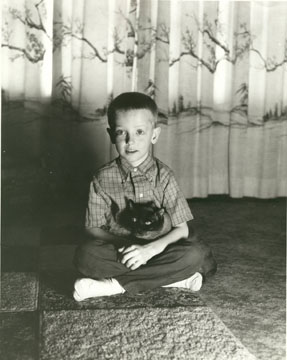
My brother Dave with Blue Eyes our favorite Siamese cat.
Showing posts with label Stephen J Rendall. Show all posts
Monday, March 26, 2012
THE COMPANY YOU KEEP
The story goes that in England there was a very famous banker who would take the 6:30 a.m. train into work each and every day. He would arrive at the bank promptly at 7:30 in time to say a hearty "good morning" to the night watchman as he was ending his shift and getting ready to return home. One day as the banker entered the bank and gave his usual greeting to the night watchman, the fellow asked if he might have a word. The banker graciously answered, "Of course", and ushered him into his office. Sitting down the night watchman said, "Last night I had a dream. I dreamt that you took your usual 6:30 train and there was a terrible accident and many people were injured and killed. May I suggest, sir, that tomorrow you take the 6:45 train?" The banker thanked the night watchman and sent him on his way. The next day, the banker thought about what he had been told and decided that it really wouldn't make much of a difference if he was 15 minutes late for work. So, just to be on the safe side, he took the 6:45 train. Sure enough, the 6:30 train was in a terrible accident and many were killed and injured. Arriving at the bank, he called the night watchman into his office and fired him. Why did he do this?
This riddle and many others were some of the delightful morsels shared by J. Sidlow Baxter, the famous British preacher, when he was in our home for a meal. I count it a great privilege to have been included, along with my brother, at many meals and coffee times with guests in my parents home. Stuart Briscoe, Ivor Powell, Don Richardson, Dr. Helen Roseveare, Dr. Stephen Olford, J. Edwin Orr and countless others are some of the people that I remember who were invited over to enjoy one of Mom's home cooked meals or fine desserts. Mom took a lot of pride, not only in the meal, but in the whole presentation. Her china was a Scottish pattern, Brigadoon, with a beautiful purple thistle pattern. This large set of china is now in the proud possession of our daughter Christy, and it brings me great joy to recognize that Mom's legacy of hospitality lives on in our daughter.
Our home was always a beehive of activity. Mom and Dad entertained constantly. It was not unusual for my Dad to show up at meal time with someone in tow that he had just met. Mom would rise to the occasion and set another plate . . . or two . . . or three . . . . From members of the church, to students, visiting preachers, missionaries, politicians and dignitaries, all were made to feel welcome in our home. A guest book was kept and it's amazing to look back through those hundreds of names and realize the impact of my parents' hospitality.
In those years Prairie had a large board of advisors made up of some of Canada's brightest business, legal and accounting minds. This board met twice a year and was always invited to our home for a meal. I have a distinct memory, that when I was about 6 years old, Frank Reimer (one of the founders of Reimer Express) handed my brother and me each a five dollar bill. He very emphatically encouraged us to get down to the bank the following Monday and start a savings account. I should have listened!
For many years, until Mom's health made it impossible, Dad would invite 10 of his students for dessert every Friday night. Over the years, hundreds and hundreds of students came to our home to see their professor outside the classroom and visit with him in a more informal setting. Mom would prepare one of her famous desserts for the occasion. Baked Alaska, rhubarb custard pie with ice cream or fancy parfaits were the order of the day.
There are a couple of life lessons, learned from observing my parents' hospitality for which I will be forever grateful. The first lesson is that they treated everyone the same. From child to student, business executive to staff member, preacher, teacher, to the odd millionaire and even billionaire, (not that millionaires and billionaires are odd, but . . . ) all were respected and honored. This sent a huge message to us as children about the value of every single person. The second is that most of the time they included us in these meals and coffee hours. Mom and Dad did not buy the axiom, "Children should be seen and not heard", but instead encouraged us to interact with these folks. Of course we needed to be respectful and wait our turn to speak (which was sometimes pretty hard, especially for me) but the experiences were rich in that they taught us a lot about different cultures, viewpoints and various styles of communicating. I believe we received an entire education just from these experiences alone.
Today, as cell phones, facebook, email, texting and twitter seem to have become the main forms of communication, human interaction seems few and far between. In this fast paced world we live in, where communication can be so very impersonal, why not consider inviting a human over for some real genuine "facetime"? As we approach summer, what a perfect time to invite that neighbor, co-worker or friend over to your home for a barbecue or pancake breakfast. Get to know something about them–their heart, their family, their interests and what they are passionate about. You could even text them the invitation!
O yes . . . the nightwatchman . . . remember he said, "Last night I had a dream . . ."?
The bank manager fired him for sleeping on the job.
www.prairieboy.com
© 2012 Stephen J. Rendall - All rights reserved.
This riddle and many others were some of the delightful morsels shared by J. Sidlow Baxter, the famous British preacher, when he was in our home for a meal. I count it a great privilege to have been included, along with my brother, at many meals and coffee times with guests in my parents home. Stuart Briscoe, Ivor Powell, Don Richardson, Dr. Helen Roseveare, Dr. Stephen Olford, J. Edwin Orr and countless others are some of the people that I remember who were invited over to enjoy one of Mom's home cooked meals or fine desserts. Mom took a lot of pride, not only in the meal, but in the whole presentation. Her china was a Scottish pattern, Brigadoon, with a beautiful purple thistle pattern. This large set of china is now in the proud possession of our daughter Christy, and it brings me great joy to recognize that Mom's legacy of hospitality lives on in our daughter.
Our home was always a beehive of activity. Mom and Dad entertained constantly. It was not unusual for my Dad to show up at meal time with someone in tow that he had just met. Mom would rise to the occasion and set another plate . . . or two . . . or three . . . . From members of the church, to students, visiting preachers, missionaries, politicians and dignitaries, all were made to feel welcome in our home. A guest book was kept and it's amazing to look back through those hundreds of names and realize the impact of my parents' hospitality.
In those years Prairie had a large board of advisors made up of some of Canada's brightest business, legal and accounting minds. This board met twice a year and was always invited to our home for a meal. I have a distinct memory, that when I was about 6 years old, Frank Reimer (one of the founders of Reimer Express) handed my brother and me each a five dollar bill. He very emphatically encouraged us to get down to the bank the following Monday and start a savings account. I should have listened!
For many years, until Mom's health made it impossible, Dad would invite 10 of his students for dessert every Friday night. Over the years, hundreds and hundreds of students came to our home to see their professor outside the classroom and visit with him in a more informal setting. Mom would prepare one of her famous desserts for the occasion. Baked Alaska, rhubarb custard pie with ice cream or fancy parfaits were the order of the day.
There are a couple of life lessons, learned from observing my parents' hospitality for which I will be forever grateful. The first lesson is that they treated everyone the same. From child to student, business executive to staff member, preacher, teacher, to the odd millionaire and even billionaire, (not that millionaires and billionaires are odd, but . . . ) all were respected and honored. This sent a huge message to us as children about the value of every single person. The second is that most of the time they included us in these meals and coffee hours. Mom and Dad did not buy the axiom, "Children should be seen and not heard", but instead encouraged us to interact with these folks. Of course we needed to be respectful and wait our turn to speak (which was sometimes pretty hard, especially for me) but the experiences were rich in that they taught us a lot about different cultures, viewpoints and various styles of communicating. I believe we received an entire education just from these experiences alone.
Today, as cell phones, facebook, email, texting and twitter seem to have become the main forms of communication, human interaction seems few and far between. In this fast paced world we live in, where communication can be so very impersonal, why not consider inviting a human over for some real genuine "facetime"? As we approach summer, what a perfect time to invite that neighbor, co-worker or friend over to your home for a barbecue or pancake breakfast. Get to know something about them–their heart, their family, their interests and what they are passionate about. You could even text them the invitation!
O yes . . . the nightwatchman . . . remember he said, "Last night I had a dream . . ."?
The bank manager fired him for sleeping on the job.
www.prairieboy.com
© 2012 Stephen J. Rendall - All rights reserved.
Friday, January 14, 2011
WRITING ON THE WALL
In August 1965, when Howard Crane packed up his earthly belongings and headed to the western plains of Canada, I'm sure he had no idea what his life would have in store. The Cranes lived in Wellsburg, NY, a small town right on the Pennsylvania border. Together with his wife and four children, Howie traveled in their 1956 Chevy for five solid days to arrive at the school. Big changes awaited the family, but they were able to settle in and slowly assimilate into Prairie life.Howie had trained as a tool and die maker and upon hearing of the need for another machinist at the school he responded. Having had some previous connection, as his youngest brother had attended Prairie High School and his sister had attended the college, he was somewhat familiar with the school. Later on his mother served on staff, working in the Prairie Bookroom. Prairie President L.E Maxwell had also shared the work of the school in the Crane's church and so it was not a complete culture shock when they arrived on campus.
For the first few years Howie worked with Mr. Zweifel or "Pa" as we knew him. Pa was from Switzerland and was a highly trained machinist in his own right. The Zweifels were our neighbors when we lived on Prairie Crescent and in the winter I would often see Pa on his cross country skis coming home from work. He also loved the mountains and made many trips to Banff and area for hiking and climbing.
You may wonder why Prairie needed two machinists but let me assure you that these "behind the scenes" workers kept the place alive and humming. Parts were machined for literally every department on the campus, from the garage to the electronics department. I remember when I was doing student work in the recording studio and we needed a bearing or some other part to keep the old tube Ampex tape recorders rolling, we would pay a little visit to the machine shop. Many of us wondered if there was anything these two couldn't make!
Prairie had a fascinating potpourri of shops. It was enough to give a young boy ADD. Every time you opened a door you would discover a new piece of machinery or someone hard at work on a project. Many a staff kid was the recipient of this unique gift. I remember times when Mom would have to deliver the little red Ford Falcon to the garage for an oil change or to have the winter tires put on and I would duck into the many shops in that area of campus. John Hamm and later Forest Cummings were right next door, always in the middle of a spark show. They ran the welding shop. We would take our broken bikes to them in the hopes that maybe the front forks could be fixed one more time. We invented "offroading" before it was popular! On some of these trips I would visit the machine shop, home of Howie Crane and Pa Zweifel.
Entering the door to the shop opened up an entire new world. Howie would greet us with a big smile and a twinkle in his eyes. Wearing a blue shop apron and clear eye protectors, he would welcome us to his place of service. Large metal lathes, milling machines and drill presses were strategically placed around the shop. Small tools of a precise nature were also important. Punches, scribers, tap wrenches and micrometers were the instruments with which these two men implemented their craft. But there was one fixture that had nothing to do with machining and everything to do with people . . . measuring people.
On one side of the shop was a dedicated wall where Howie would measure every visitor who was willing to stand against it - heels in, shoulders back, chin out. Howie would get his stainless steel ruler from his desk and placing it on our heads he would carefully mark a small line on the wall and write our names and the date. As the years went by hundreds of staff kids were measured on this wall in many colors of ink and pencil. A real work of art. It was fascinating to watch the growth of not only yourself but also your friends. Howie always engaged us in meaningful conversation as he patiently went about the documenting of our heights. I have often said I wished Prairie had been able to preserve that section of the wall for the museum, because of the enormous human element attached to it.
In a recent note from his oldest daughter Gil, she shared the following memories: "We kids used to hang out at the machine shop when we could. I would sweep the shop for him and clean the sink. With the dime he would give me, I would go to the Staff Store for a box of Smarties to share with him. Dad had a big metal block with different sized holes in it, and a box of various sized screws - a puzzle block. I would try to fill as many holes as I could with screws. A wonderful way to keep a child busy. It was always fascinating to watch him create parts for various machines on the variety of lathes. He taught me how to use vernier calipers. He was amazingly particular, down to thousands of an inch, incredibly precise, always calm and patient. Even as a young child I realized that he was of amazing character."
Sometimes it is the seemingly little things that we do that can have long term impact. Howie's soft spoken demeanor and thoughtful care for people won him friends young and old, many who are still in touch with him to this day. Thanks to Howie we also began a wall at our home when we were kids. Dad would measure us up against the cinder block wall of the Crescent house. When Cathy and I got married and had children we carried on the tradition. From our kids to their friends and visitors, sometimes even pets, all were logged on the wall. When we sold our last house in Three Hills, my Aunt Lois painstakingly transcribed every line off the wall to a long sheet of paper to be copied over to a new wall.
So if you come over for a visit and you see me fetching a pencil and a ruler, you had better measure up!
www.prairieboy.com
© 2011 Stephen J. Rendall - All rights reserved.
Wednesday, January 12, 2011
AMAZING GRACE AND ROCK 'N' ROLL
I will never forget the day my Dad showed up with a new stereo. This particular model was housed in a nice wooden cabinet with separate speakers and bore a gold embossed logo - Silvertone. Just the name alone conjured up mystery and stirred my imagination. This meant two things - that our family would now be able to enjoy listening in stereo with a much higher fidelity then we had previously and that my brother and I would be the recipients of the old mono suitcase phonograph player.Dad proudly set up the new stereo in front of the big picture window in the living room of our little house. He placed the unit on a large wooden stand with room for storage of LP's down below and spaced the two speakers out on either side. Our new stereo system had a stacking mechanism allowing for the placement of a half dozen or so LP's on it. One record would finish and another would drop and they would play in sequence. This feature made the player almost like a small home jukebox. I'm pretty sure the scratches inflicted on these vinyl records falling on top of each other was quite damaging, but nobody thought of that at the time. Dad was very careful with his record collection, making sure that he held them with his thumb on the edge and a finger in the middle, so as not to get any fingerprints on the vinyl itself. He had a small cleaning kit which he used to remove dust with the velvet roller. Each and every record promptly went back in its proper sleeve and dust jacket. When Dad placed a record on the machine the glorious sounds of stereo filled the room. It might not have been heaven, but maybe it was a little taste?
Outside of books, Dad loved his records and collecting music. He would frequently come home from the Prairie Bookroom with the latest titles by Rudy Atwood, The Sixteen Singing Men, Tennessee Ernie Ford and a host of others. Christmas music was also important in our home and every Christmas a few more albums were added to the collection. Classics like Bing Crosby and Perry Como were brought home for us to enjoy. The Bookroom's strict music policies seemed to be more relaxed with Christmas music and a lot of "worldly" holiday music managed to sneak its way in the door. One of my Aunts, I'll call her Rachel, because that is her name, kept several of her records at our house so as not to incur any displeasure from Grandpa and Grandma. What better place to store them than at the house of her older sister who was married to a preacher! The original Sound Of Music soundtrack, featuring the clear voice of Julie Andrews and a sampler record that included Patti Page singing How Much Is That Doggie in the Window?, were a couple of the titles I recall.
Dave and I placed the little mono record player in our room and would listen for hours to the various story and song LP's that Dad would buy for us. We enjoyed Black Beauty, Seven at One Blow, Dick Whittington's Cat and a variety of Bible stories. Many nights we would fall asleep while the records played and Mom or Dad would come into our room, lift the needle off the player and shut off the machine. I remember Dad buying the soundtrack to Chitty Chitty Bang Bang long before we had ever seen the movie. As we would listen, our imaginations would fill in the scenes and action and in effect, create our own movie.
Dad, being the loyal Scot that he was, loved the bagpipes and had a few LP's of various pipe bands. Our family had experienced and enjoyed one of the largest drum and pipe festivals in the world when we visited Edinburgh in 1970. Each band, dressed in their kilts with tartans representing the various clans, cut a colorful swath across the vast lawns of Princess Street Gardens at the foot of Edinburgh Castle. Yelling out terse commands, the drum major led the group, holding a highly polished mace in his hands. One of the other highlights of that summer was being able to attend the Royal Edinburgh Military Tattoo. This is an annual series of military tattoos performed by British Armed Forces, Commonwealth and international military bands and display teams. The event takes place annually throughout August, as part of the wider Edinburgh Festival.
A recent article in the Edinburgh Castle paper describes the event this way:
"In the glowing twilight, the floodlit Edinburgh Castle draws all eyes, a hush falls and darkness deepens. Then the great oak gates of Edinburgh Castle sweep open, and the swelling sound of hundreds of pipes and drums cracks through the night sky. Emotions run high: the Edinburgh Military Tattoo unfailingly enthrals, symbolising the Scotland that everyone holds dear in their heart.
Now a dazzling show is spread out on the Castle Esplanade, a whirling and colourful kaleidoscope of music, dance and display. It may be exciting - daredevil motorcycles at speed and the breathtaking re-enactment of battles, or exotic - Turkish music and Chinese dancers, or simply the best of Scottish - Highland dancers wheeling and swirling to a fiddle orchestra.
Then the audience gather themselves together for the finale of the Edinburgh Military Tattoo. All 1000 or so performers on the Castle Esplanade, column after column of marchers, dancers and bandsmen. The Tattoo audience joins in a great chorus of singing, cheering, and applause; cries of 'Bravo!' before a hush falls for the singing of the Evening Hymn, the sounding of the Last Post and the lowering of the flags on the Castle.
Finally, all faces turn to the Edinburgh Castle ramparts, where a single spotlight cues the Lone Piper of the Edinburgh Military Tattoo to play his haunting lament, the high notes echoing across the still night sky and over the dark Edinburgh skyline, as the flames of the Castle torch lights and the piper's warming brazier flicker and slowly die.
At the Edinburgh Military Tattoo fireworks burst out from the Castle against the black sky, but the spell is not broken, for when the crowd sing Auld Lang Syne and shake their neighbour's hand, the emotions linger, and the heart is full. Goers to The Edinburgh Military Tattoo all united in international friendship, the shared love of Scotland, its music and its traditions."
As the fog rolled in from the sea and the sound of the pipes echoed throughout the castle and across the city, it became an unforgettable experience for our family.
I'm not sure which is more maligned - the bagpipes, the banjo or the violin, but the bagpipes certainly receive their fair share of jesting. It is said that the Irish sent the bagpipes over to Scotland as a joke . . . and the Scots still haven't caught on! Alfred Hitchcock once said, "I understand the inventor of the bagpipes was inspired when he saw a man carrying an indignant, asthmatic pig under his arm. Unfortunately, the man-made object never equaled the purity of sound achieved by the pig". A friend of mine once asked me what the definition of a gentleman was. The answer, he claimed, was a person who knows how to play the bagpipes but doesn't.
A friend of Dad's knew he was a big bagpipe fan and presented him with a small gift. It was a 45 record with a bright orange label in the center housed in a plain white paper sleeve. The 45, was another musical reproduction device in a line of many, starting with wire recordings, wax cylinders, 78's and 33 1/3 LP's, to name a few. The 45 had a large hole in the center necessitating the use of a little plastic adapter to enable it to be played on standard phonograph machines. For many years this became the medium of choice for the record companies to service radio stations, hence the name "single", as only one song appeared on either side. Record stores would also sell them and I collected many throughout my high school years.
The title of Dad's gift was the classic recording of "Amazing Grace" by the combined bands of the Royal Scots Dragoon Guards. This recording had reached number one status in the charts in the United Kingdom, Ireland, Australia, Canada and South Africa. The recording was originally released in 1971 to mark the amalgamation of the Royal Scots Greys and the 3rd Carabiniers, to become the Royal Scots Dragoon Guards, Scotland's only cavalry regiment. The album first appeared on the RCA label and it was this recording which gained the band's world renowned fame, selling over 6 million copies of the tune when it was released as a 45.
Being the curious kid that I was, I decided to check out the B side of the little black vinyl 45. On this particular edition, the distributor of the single, had decided to put an unrelated group on the opposite side of Amazing Grace. What met my ears were the heavy sounds of a rock band a la Deep Purple or T. Rex . This was a brand new sound to me. The punchy drums and powerful guitars were something I thought I could get used to! As the song says, "It's Only Rock 'n Roll, But I Like It".
Occasionally, when we arrived home from school, Mom would have left a note on the table or door letting us know that she would be right home. Sometimes she would be called out on church business or be off on a project or committee meeting. We were pretty independent and would make ourselves a sandwich, grab an apple or some cookies and go outside to play or listen to the stereo.
Every Saturday morning the Institute held a weekly staff meeting. Attendance was mandatory for both staff men and women. To aid in this endeavor, the school provided a babysitting service. Bible school girls were assigned to different homes as part of their student work. The girl would arrive just before 8 o'clock and leave right at 9. Many times Mom and Dad would visit with other staff and wouldn't arrive home until 9:30 or so.
After the discovery of this new musical art form, I decided that a scientific experiment was in order - one along the lines of acoustic research. Taking advantage of the small time window when the babysitter left and my parents weren't yet home, I hauled both of the speakers from Dad's stereo into the front doorway and stacked them up one on top of each other. Pointing them in the direction of the elementary school, I enlisted my brother as my research assistant. I cranked up the B side of that little 45 and then dispatched Dave to walk down towards the school and see just how far he could hear the music. I kept an eye out for Mom and Dad or an annoyed neighbor or two. Evidently the stereo put out quite a healthy decibel level, because on Dave's return, he reported that he could hear the music all the way down at the elementary school. I'm sure that the noise emitting at that level was completely distorted, but it brought me a great deal of satisfaction that I had effectively "covered" the neighborhood with my gift. Working quickly, we had the whole thing put back in its place, playing the sweet sounds of the Sixteen Singing Men upon Mom and Dad's return. I don't think any neighbor ever reported us to our parents nor did any of them call the cops. They were probably all at Staff Meeting as well.
Every time I hear the haunting strains of the bagpipes, I smile to myself and think of the day I found Amazing Grace and discovered Rock 'n' Roll.
www.prairieboy.com
© 2011 Stephen J. Rendall - All rights reserved.
Sunday, April 25, 2010
STRIPPER WANTED
Back in it's heyday, Prairie was a vertically integrated organization that understood economy of scale better than most. This was long before these terms were commonly used in the business fabric of today. One of those vertically integrated areas was the Graphics and Printing Department. A host of sub-departments such as the print shop, art, pre-press, photography and mailing were all under this umbrella. This structure handled all of the printing needs for the schools in addition to printing and distributing three or four magazines.Printing had been a long tradition at Prairie, starting sometime in the 1930's with lead type machines and ending in the 1990's with high-tech Heidelberg colour presses straight from Germany. It is interesting to note that PBI acquired their first press from a disposal sale of seized property. The press in question had actually been used to print counterfeit money!
Employing twenty to thirty people at it's peak, there always seem to be a need for qualified workers in the printing department. Advertisements for these job openings were placed in various magazines, brochures and newsletters that the school would print and distribute. There were a number of American citizens on staff and the personnel department would assist these folk with their visas and immigration documents to allow them to move to and work in Canada. Many of the border officials in Washington, Idaho, Montana and North Dakota became familiar over the years with not only the name of the school, but some of the individual staff members and students as well. There was a constant flow of students and staff and usually the officers were quite cooperative and civil, making for an easier transition back and forth.
My friend Harold Leo graduated from the school in the '70's, moved back to the United States, married and settled down. Harold was made aware of a need in the pre-press department at the school and so applied for the job and was accepted. I count it a great privilege to have worked with Harold during the Harvest Music label era. You won't find a more conscientious and hard worker than Harold. With all their worldly belongings in tow, Harold and his wife Debbie headed off to Canada. At the border they were asked to produce their paperwork, including the letter of acceptance from the school, for the job in question. Normally this process could be quite lengthy, so they braced for the worst. Harold handed the officer the letter and waited for her response. Looking up, the officer said, "What the @#$% does a Bible school need a stripper for?" On the letter it said that Harold was being accepted at the school in the position of stripper! After reviewing the documents, the border guard finished her interview and with a wry smile, looked at Harold and said, "Well, if PBI wants a male stripper they can have you. Get out of here!" The whole process had taken no more than fifteen minutes.
For those unfamiliar with the terms used in the printing business, back in the dark ages and well into the '90's, pre-press specialists were commonly called ... strippers. The job of a stripper was to photograph galleys and piece together, or "strip", the film so press plates could be burned. They would work with negatives, film and plates to make sure the finished printing job was accurate and in proper register. The personnel department had simply used the term popular at that time for this position and had inserted it into the letter of acceptance. Harold quickly explained that it would not be him who would be doing the stripping. Well, actually it would be him stripping, but a different type than the officer was thinking of. He then explained a bit about the job. I'm sure the customs officers had a good chuckle over that for weeks to follow.
www.prairieboy.com
© 2010 Stephen J. Rendall - All rights reserved.
Monday, April 5, 2010
TUNNEL OF LOVE

A Canadian winter can be a cruel mistress. Punishing temperatures of minus forty, several feet of snow and drifts to the tops of fences are not unusual. Some claim to actually enjoy the cold weather, other snowbirds leave and go south to Arizona or Florida, some of us had no choice. The winter of '74 was particularly frosty and we had pretty much settled in to our routine of school, hockey and sledding. For the high school kids there were not a lot of places to go for any type of "warm fellowship" where there were not deans, counsellors or staff looking over their shoulders at all times. There was however an underground hiding spot that was warm and very accessible to those with the creativity to recognize its potential.
In 1974 Prairie Bible Institute heated all of its homes, shops, classrooms and administrative buildings by steam. Cast iron radiators would rattle, bang, spit and hiss letting you know that all was well, the heat was flowing and you would be warm during the freezing winter weather. In those days the boiler plant, as it was called, was manned twenty four seven and was fed with mountains and mountains of coal. Out from this central boiler plant spread a system of steam tunnels that made their way to every corner of the campus. Like an octupus's tentacles there were literally miles of these tunnels. Inside the tunnels ran large insulated steam pipes, telephone lines and other mechanical infrastructure as needed by the large campus. In most places if a person would stoop over they could walk inside the tunnel. The insulation was not completely efficient allowing some heat to escape, effectively heating these tunnels.
The tunnels were primarily underneath the sidewalks giving the added benefit of melting the snow. This made less work for the maintenance crew in the winter months. It turned out to be quite a clever idea. In a few areas there were larger "rooms" as the tunnels veered off and headed in other directions. You could start at the boiler plant and go all the way up the hill and come out at several junctures along the way. You could work your way south and magically appear inside the girls dorm. Access to the steam tunnels took on various forms, but the most common were metal man hole covers that were placed in the sidewalk. Most of these were about 24 inches around, but there were some that were approximately 4 feet by 2 feet in size. When you opened one of these covers you were likely to be met with a group of salamanders laying in a pool of muddy water. These prehistoric looking creatures would scurry away as the light would pour into the tunnel. The tunnels were also home to silverfish, spiders and mice, making most of the girls somewhat reluctant to explore with us in this creepy underworld.
As it turns out - there were a few brave ones!
At 9:00 sharp the bell rang signaling another school day beginning at Prairie Elementary School. As we took our seats that morning the classroom was a buzz of talk of a fire the night before. The fire was said to have occurred right behind the school and that there was the evidence right outside to prove it! When the recess bell rang at 10:30, a group of us rushed to get our coats, boots, toques and mittens on and go outside and inspect the scene for ourselves. Sure enough, just to the west of the the two schools, right outside the large man hole cover leading into the steam tunnels, lay a massive heap of charred carnage with huge icicles encrusting the entire mess. What in the world?
This was a most curious sight. Upon closer inspection we could make out several mattresses, winter coats, some blue jeans, parts of a T shirt or two, and a tennis shoe. Along with the clothing items there appeared to be some broken glass and pieces of metal, mixed in with the icy charred remains. Perhaps most shocking to us were the blackened remains of a bra, some briefs and a number of beer bottles. Just the mention of the word bra was enough to send us grade eight boys off chortling and whispering among ourselves. Mix in beer bottles and our imaginations went wild.
PBI owned a small rustic resort on Pine Lake which was about 45 minutes north west of the campus. On about 50 acres of water front were 9 simple cabins where staff and students could go for a weekend of fishing in the spring or a couple weeks of summer holiday. ( Pine Lake will be the subject of another blog. ) Every fall, a crew of men would go up to the lake and bring home all the mattresses, coal oil lamps and other valuables from the cabins. These were put in storage until the spring when they would be needed again. Unkown to the powers that be, some of these items would find a use before the spring.
Several enterprising high school students had discovered this stash of supplies and having some knowledge of the steam tunnel system, put their plan into motion. Breaking into the storage garage late one night, they helped themselves to several of the mattresses and coal oil lamps. Carrying them several hundred yards to this particular entrance to the steam tunnels, they proceeded to set up a homey little love shack.
Now it is not my place to judge what occurred that night, as I was not present to witness this gathering. But I think it would safe to say that there was most likely some "laying on of hands" taking place at a minimum. At some juncture in the activities, someone knocked over one of the coal oil lamps and the whole shootin' shebang went up in flames. With no time to gather their personal effects, the kids were fortunate to have escaped with their lives and the hair on their heads. The fire department was called, the fire doused and all of the blackened remains were hauled up out of the tunnel and placed outside the entrance on the ground. This was the sight that greeted us the next morning when we arrived at school.
It wasn't long until a crew was dispatched and all of the "evidence" removed. Our young minds were left thinking - "What went on in that tunnel that night?". . . and . . . "It must have been a very cold jog for those kids heading back to their various places of abode that frosty winter's eve!"
www.prairieboy.com
© 2010 Stephen J. Rendall - All rights reserved.
Labels:
Fire,
PBI,
PHS,
Pine Lake,
Prairie Elemntary School,
Steam Tunnels,
Stephen J Rendall,
Steve Rendall
IT'S ALL IN THE NUMBERS

In the summer of 1975 I was 14 years old. Summers for Prairie Bible Institute were particularly challenging times as most of the students were gone and the cash flow diminished. Staff still had to be paid and summer maintenance programs undertaken. This summer was no different. My father was a Vice President at the Institute as well as teacher, preacher and editor of the schools flagship publication; the Prairie Overcomer. Dad usually would get home from work fairly late and so it was around 6:30 this day when he showed up for supper with a rather happy look on his tired face.
Normally Dad would arrive just in time to tune in "As It Happens" on the CBC or perhaps catch the daily broadcast of the "Haven of Rest." His little Sony transistor radio lived on the kitchen table and was our families source of news and entertainment programming around the super table. Tonight though, before he bowed his head to say grace, he informed us of a special provision that the school had received that very day.
An envelope had arrived that afternoon in the regular post addressed to Dad from a man in Florida. This fellow, though never having attended the school, had been following it's work through the Prairie Overcomer for many years. Dad related that the accompanying letter had instructed the administration to use the enclosed check as they saw fit and that more funds would be arriving in coming days. We all agreed with Dad that this was great news as we knew how tough the summer months could be for the school.
Never one to be overly shy, I asked Dad just how much money this man had sent as it seemed to have made a considerable impression on him. Dad informed us that the check was for ten thousand dollars! (10,000.00) This was astonishing and I asked Dad if I could see the check. Dad went off to his briefcase and promptly produced the paper in question.
As my teachers, classmates, and business associates will tell you, math was never my strong suit. Evidently it wasn't my Father's either. As Dad handed me the check and I began to examine it, I did a double take. There were not four zeroes before the period, there were six. (1,000,000.00) That's right, I held in my hand a check for one million dollars! I looked at it again - yup, that is was exactly what it said. I exclaimed to Dad - "Take a look at this, it's for one million dollars!" Dad said, "It can't be," and as I handed it back to him his eyes grew wide as the realization of the size of this "provision" sank in. The next time you get a check . . . check the numbers!
www.prairieboy.com
© 2010 Stephen J. Rendall - All rights reserved.
Labels:
As It Happens,
CBC,
Haven of Rest,
PBI,
Prairie Overcomer,
Sony,
Stephen J Rendall,
Steve Rendall,
T.S. Rendall
Sunday, April 4, 2010
ONCE A KNIGHT

Note: There will be a few stories about an English teacher by the name of Mr. Knight. He was a most colorful character and will be featured in coming days. I do want to share a short story that I had forgotten about. The class in question was a couple of years ahead of us, so I was not present to be a witness. This was sent to me by a student that was in the class when the following occurred:
ONCE A KNIGHT
The Knight family moved from Waupaca, WI to Prairie in the summer of 1974. At that time, there were four children - Tim, Dan, Mark, and Jane. Ben was added in 1977 and Ruth in 1981.
Mr. Kenneth Knight taught English and was a bit of a legend when it came to providing fodder for crazy stories. As it happens a group of girls came across a plaque which they thought would make a fitting presentation for their favorite English teacher. This group of rather naive (maybe not?) girls made arrangements with him to make a formal presentation in front of the entire class.
The plaque read:
“ONCE A KING ALWAYS A KING, BUT ONCE A KNIGHT IS ENOUGH!"
The guy that sent me this anecdote told me that he about fell out of his desk laughing, Mr. Knight had a good laugh while turning beet red. What else could he do?
www.prairieboy.com
© 2010 Stephen J. Rendall - All rights reserved.
(Thanks to Tim Knight for supplying the photo of the original plaque!)
Labels:
English Class,
Ken Knight,
KIng,
Knight,
PBI,
PHS,
Stephen J Rendall,
Steve Rendall
Subscribe to:
Posts (Atom)


