Showing posts with label Ted Rendall. Show all posts

Saturday, October 21, 2017

THE WRECK OF THE ISLANDMAGEE


At around 5:00 o'clock on the afternoon of October 26, 1953, the merchant ship, Islandmagee set sail from the port of Birkhill, Scotland bound for the Port of Leith, also in Scotland. Her cargo that day was approximately 200 tons of wet sand. As often happens in the North Sea, a storm gale came up that quickly turned into a force 9 storm. Onboard the ship was a crew of 6. One of those men was my grandfather, James Rendall or as his family and friends called him; Peemo. Born on the island of Westray in the Orkney Islands, Scotland, my grandfather was the eldest of 15 children.

That fall, my father had made the long trip by ship from his home in Leith, Scotland to attend college at what is now Prairie College in Three Hills, AB, Canada. Taking the train from Edinburgh, Scotland to South Hampton, England he set sail on an Italian liner across the Atlantic, landing in Montreal, QC. Having been at sea for 6 days he then made his way by train another 5 days over the 2200 miles to the little town in the middle of the prairies. The setting could not have been any more different from the culture and topography that he had left behind. Enrolling that September, he took to his studies with vigor and quickly became one of the top students to have attended the school.

  • (Dad with his friend, George Bethune on the ship from South Hampton to Montreal)

In November of 1976, I was 15 years old. One particular day I was glued to my little AM radio, as I often was, surfing the airwaves for anything that would catch my ear. The haunting strains of an electric guitar, a steel guitar and an acoustic 12 string guitar soared across the airwaves. After the distinctive introduction was over the iconic voice of Gordon Lightfoot began to sing . . . "The legend lives on from the Chippewa on down . . ."  ~ I was hooked! I had never heard anything that remotely sounded like this and as the song unfolded I realized that it was a "story song". It told the tragic tale of the bulk carrier, the SS Edmund Fitzgerald that sank in Lake Superior hauling iron ore from Duluth, MN to Detroit. MI on November 10, 1975. 29 men lost their lives that night in the awful storm. When launched on June 7, 1958, she was the largest ship on North America's Great Lakes and she remains the largest to have sunk there. While Gordon certainly took some artistic license in the telling of those events, he captured the essence of the horror in a very real way. When he sings at the end of the song, "The church bell chimed till it rang twenty-nine times", you can almost feel the hushed reverence and solemnity that surely was present that day.

As I often did when I made a new discovery and was excited about something, I went to find my Dad. I told him that I had just discovered a new song on the radio I thought he would like and I would play it for him the next time it came on. I knew Dad loved ships and the sea and I thought this would be right down his alley. Always trying to support my endeavors, Dad said that would be just fine and to let him know when the song played again.

A couple of hours later the song came on and I rushed upstairs from my little basement studio / shop to find Dad sitting in his chair. He was probably studying or marking papers, his normal activity on any given evening in our home. Turning up the song I looked at Dad expectantly for his affirmation of what a truly great song this was, and what great taste I had! Dad began to look agitated, even irritated as the song played on. Now the Wreck of the Edmund Fitzgerald did not follow the typical pop formula of a 3 minute song. It actually clocks in at 6 minutes and 40 seconds. As we sat in the living room for those long painful minutes, the atmosphere grew more and more awkward. Finally the song came to an end and Dad said, in maybe the most serious tone of voice I had ever heard him speak, "Son, NEVER play me that song again!" I was shocked and confused. Was the song too rock 'n roll? Was there an offensive lyric that I hadn't caught? Then, to my youthful, naive self the light went on. It finally computed and I felt absolutely horrible.

You see, on that fateful day of October 26, 1953 the Islandmagee took on water and sank, taking with her the entire crew including my Dad's father and my grandfather, gone at the age of 52. There was compelling evidence that at least some of the crew had made it into one of the life boats, but it sank as well. All the crew except my grandfather were washed up on the coast of Fife still wearing their life jackets. The hypothesis is that my grandfather rushed to launch the lifeboat which would have been tied down on deck as his leather knife holder was found in the boat later floating in the sea. He did not have time to put on a life jacket.

In what the papers referred to as a, "double tragedy", the Arbroath life boat Robert Lindsay and the Anstruther life-boat James and Ruby Jackson were both dispatched to the scene in answer to the distress rockets which had been seen three miles east of Fifeness as well as the calls of mayday on the radio. The Anstruther life-boat returned empty handed but the Arbroath boat also went down into the dark abyss. All but one of her crew perished as well. A court inquiry held in February of 1955 found, and I quote; "The Court is therefore of the opinion that the evidence does not disclose that the casualty to "Islandmagee" was caused, or contributed to, by the fault or default of any person or persons." In simple terms, it was down to mother nature or as the insurance companies like to call it, "an act of God", and that night in the North Sea, she was a harsh mistress. 

The next day, October 27th, Dad received a telegram from his older brother Gavin with the cryptic message, "Father, lost at sea ~ Gavin". Dad had no money to make his way back to Scotland for the funeral and to be with his family as he had spent every penny he had to emigrate to Canada to attend school. In many ways he grieved alone. He had just turned 20 years old in August.

In today's vernacular, psychologists and counselors use the term "trigger", a word used to describe sensations, images or experiences that trigger a traumatic memory. This term is often used in relation to Post-Traumatic Stress Disorder (PTSD), of which there is an increasing awareness. In 1976 I had never heard of the word "trigger" other than my experiences with target shooting or in reference to the palomino horse ridden by Roy Rogers in the movies. It was not until the song had ended and Dad had made his proclamation that I finally realized what had happened. Growing up, Dad hardly ever spoke about his father and the pain of his loss. He had found ways to cope. The song and it's graphic retelling of the tragedy of the Edmund Fitzgerald was just way too close to home. Twenty three years later, the event was still raw.

Now while I might be forgiven for my lack of sensitivity, given my age and naiveté, I realized then, maybe for the first time, something of the pain Dad carried from losing his father at such a young age. It was something he rarely talked about. I had no intention of hurting my father, I just hadn't connected the dots.

I learned an important lesson that day, one I have always tried to keep in the back of my mind. Miller Williams sums it up nicely in these words, “Have compassion for everyone you meet, even if they don't want it. What appears bad manners, an ill temper or cynicism is always a sign of things no ears have heard, no eyes have seen. You do not know what wars are going on down there where the spirit meets the bone." 


                                             Salvaged ship's bell from the Islandmaggee


THE WRECK OF THE EDMUND FITZGERALD

Gordon Lightfoot

The legend lives on from the Chippewa on down
Of the big lake they called 'gitche gumee'
The lake, it is said, never gives up her dead
When the skies of November turn gloomy
With a load of iron ore twenty-six thousand tons more
Than the Edmund Fitzgerald weighed empty
That good ship and crew was a bone to be chewed
When the gales of November came early
The ship was the pride of the American side
Coming back from some mill in Wisconsin
As the big freighters go, it was bigger than most
With a crew and good captain well seasoned
Concluding some terms with a couple of steel firms
When they left fully loaded for Cleveland
And later that night when the ship's bell rang
Could it be the north wind they'd been feelin'?
The wind in the wires made a tattle-tale sound
And a wave broke over the railing
And every man knew, as the captain did too,
T'was the witch of November come stealin'
The dawn came late and the breakfast had to wait
When the gales of November came slashin'
When afternoon came it was freezin' rain
In the face of a hurricane west wind
When suppertime came, the old cook came on deck sayin'
Fellas, it's too rough to feed ya
At seven pm a main hatchway caved in, he said
Fellas, it's been good t'know ya
The captain wired in he had water comin' in
And the good ship and crew was in peril
And later that night when his lights went outta sight
Came the wreck of the Edmund Fitzgerald
Does any one know where the love of God goes
When the waves turn the minutes to hours?
The searches all say they'd have made Whitefish Bay
If they'd put fifteen more miles behind her
They might have split up or they might have capsized
They may have broke deep and took water
And all that remains is the faces and the names
Of the wives and the sons and the daughters
Lake Huron rolls, superior sings
In the rooms of her ice-water mansion
Old Michigan steams like a young man's dreams
The islands and bays are for sportsmen
And farther below Lake Ontario
Takes in what Lake Erie can send her
And the iron boats go as the mariners all know
With the gales of November remembered
In a musty old hall in Detroit they prayed,
In the maritime sailors' cathedral
The church bell chimed till it rang twenty-nine times
For each man on the Edmund Fitzgerald
The legend lives on from the Chippewa on down
Of the big lake they call 'gitche gumee'
Superior, they said, never gives up her dead
When the gales of November come early


The Wreck of the Edmund Fitzgerald
Lyrics © Moose Music Ltd. / Early Morning Music Ltd.

https://www.youtube.com/watch?v=9vST6hVRj2A

www.prairieboy.com

© 2017 Stephen J. Rendall ~ All rights reserved.

Monday, March 26, 2012

PET CEMETERY

It was a blustery Sunday in early June. I had just turned 10, finishing the fourth grade, (I hoped) and all was well in the world . . . at least in my world . . . or so I thought. As the school year was winding down, I was looking forward to a two month vacation to Britain and Europe with my parents and my brother Dave. The lilacs had finished blooming and were beginning to turn brown. Gardens were in full growth in the neighborhood. The days were long, the nights short and it felt good to be alive.

That Sunday my brother and I took our usual places in the back seat of the red Ford Falcon and off we went to church. As we passed the Three Hills hospital on our way east out of town, I spied what appeared to be a dead rabbit in the center of the road. Its coat not fully turned from the snowy white of winter, it lay lifeless on the black asphalt. I pointed the roadkill out to the family, Dad avoided the carcass and we continued on our way.

Pets played a very important role in our home when I was growing up. Both of our parents realized the importance of animals and went above and beyond the call of duty to indulge our whims for various creatures. I have often quoted the saying, "watch how a person treats an animal and I will know a lot about their character". While I realize that there are exceptions, this has proven itself to be true many times in my observation. Neither Mom nor Dad grew up with pets and Mom was not a big fan of most of them, even on a good day! At any given time, we had turtles, fish of every description - goldfish, guppies, sword tails, angel fish, cats, dogs and rabbits. We even tried to keep minnows alive that we had caught in Pine Lake. This doesn't count the creatures we brought home like salamanders, butterflies, bees, beetles and anything else that moved that we could stuff into a box or jar.

As we were leaving the parking lot after church, Dad pulled the car over to the side of the road."Boys", he said. "I have some very sad news to tell you." Dave and I sat in the back of the car wondering what on earth could be so life shattering that Dad needed to tell us right then and there. He continued, "You know that dead animal we saw this morning on the way out of town?" "You mean the rabbit?" I said. Dad paused, "I don't think that was a rabbit," he said. "I am quite sure that is Blue Eyes." We sat there in shock. Blue Eyes was our very favorite Siamese cat. Ever the optimist, I declared, "I don't think so." I knew that the rabbit coats were still changing from white to the brown of summer and thought for sure that's what it was.

Mom chimed in, "We really hope it isn't, boys, but Dad and I felt we should tell you before we went home. He didn't pull over and check this morning, because he didn't want you to be upset all through church." We were speechless . . . Dad slowly pulled the car back out on the road and we continued back to town. That five miles was stone silent. They seemed to take forever. As we approached the spot on the road, Dad pulled over and got out of the car. He walked over to the carcass lying on the road and lifted it up. He was right, it was Blue Eyes. Dad gently placed the lifeless little body into the trunk. Opening the car door, he told us how sorry he was for our loss.

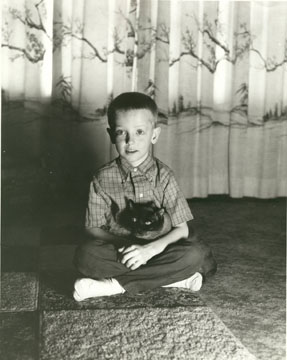
Siamese cats have gotten a bad reputation in certain circles and in come cases, rightly so. They can be territorial and temperamental and have been known to attack on occasion. They can also be extremely smart and loyal. Ours was the latter. We boys bonded with Blue Eyes. He could open the door of our bedroom at night by getting one paw underneath, and shaking it until it opened. He would then jump up on one of our beds. We received Blue Eyes as a small kitten from Doctor Paulsen, the local optometrist. At the same time, my friend Stan Kirk and his family acquired male and female kittens that they named Ahab and Jezebel. Our name was not nearly as creative, but Blue Eyes was intelligent and affectionate and we loved our cat. He even had his 15 minutes of fame, starring with my brother Dave on the cover of the school's magazine, Young Pilot. Not quite Rolling Stone, but it was a start!


This was the first time that either of us had dealt with any serious loss. For those of you who have loved a pet and lost it, you know exactly what I'm talking about. We did lose two box turtles when I was about 5 and Dave, 3. Dad brought them home and we decided the was no better thing to do than to hold a turtle race. Taking them outside and placing them on the same line on the sidewalk, we waited for the action to begin. On your marks, get set, go!  . . . nothing. The turtles didn't move an inch. In fact they didn't even stick their heads out for a look around the neighborhood. We were so disappointed. Then, all of a sudden one of them poked its head out of the shell and slowly began to inch forward. We got so excited we began jumping up and down, screaming and laughing. Unfortunately for the turtles, neither of us were very good dancers even then and our clumsy steps resulted in our little shoes making contact with the turtles and they came to a sad demise. But our beautiful Siamese cat? That was something altogether different.

Over lunch, we decided that the dignified thing to do was to give our beloved Blue Eyes a proper burial. The four of us gathered out in the ditch, about 60 feet from our front yard at 102 Prairie Crescent.  By now Dad had put the body in a cardboard box. He dug a hole, put the small casket in and covered it over with dirt. Dave and I cut some beautiful pink peonies from one of Mom's favorite bushes, and placed them on the little mound of dirt. We put a small stake on the grave with a little placard that simply said, "BLUE EYES". We stood in that grassy ditch in the wind and rain, we boys in our little yellow raincoats, Mom holding her blue umbrella, trying to come to terms with our grief.

I took my place in class that Monday morning a little worse for the wear. After the events of Sunday, I hadn't slept very well.  Just before class started, a boy who sat in front of me made a very loud proclamation. "Yesterday when we were driving out of town, a cat ran out in front of our car. My Dad hates cats, so he sped up and hit it. He killed the cat!" This was all said triumphantly, almost like someone was announcing a battle victory. I couldn't believe my ears. A light bulb went on in my head as I had never realized that there were adults who held such disdain for animals. Choking back tears, I sat at my desk in stunned silence. I didn't have the emotional fortitude or the words to say anything to this boy. So I said nothing. Not at recess. Not even after school. Actually, not ever.

I ran home at lunch and blurted out the whole story. I had found the murderer of our cat. I wanted Dad to do something. While both Dad and Mom were extremely sympathetic towards us, Dad wisely counseled that there was very little he could do. The man could very easily say it was an accident and there was no way of proving his son's rendition of the story. Dad said if the man did do it on purpose, we would both need to work at forgiving him and suggested maybe we could pray that in the future he would be kinder to animals. (I am still working on the forgiveness part!)

Enjoy your pets. Appreciate them. Be kind. Care for them. If you don't have a pet, consider it . . .

Maybe don't start with a turtle.

www.prairieboy.com

© 2012 Stephen J. Rendall - All rights reserved.


My brother Dave with Blue Eyes our favorite Siamese cat.

THE COMPANY YOU KEEP

The story goes that in England there was a very famous banker who would take the 6:30 a.m. train into work each and every day. He would arrive at the bank promptly at 7:30 in time to say a hearty "good morning" to the night watchman as he was ending his shift and getting ready to return home. One day as the banker entered the bank and gave his usual greeting to the night watchman, the fellow asked if he might have a word. The banker graciously answered, "Of course", and ushered him into his office. Sitting down the night watchman said, "Last night I had a dream. I dreamt that you took your usual 6:30 train and there was a terrible accident and many people were injured and killed. May I suggest, sir, that tomorrow you take the 6:45 train?" The banker thanked the night watchman and sent him on his way. The next day, the banker thought about what he had been told and decided that it really wouldn't make much of a difference if he was 15 minutes late for work. So, just to be on the safe side, he took the 6:45 train. Sure enough, the 6:30 train was in a terrible accident and many were killed and injured. Arriving at the bank, he called the night watchman into his office and fired him. Why did he do this?

This riddle and many others were some of the delightful morsels shared by J. Sidlow Baxter, the famous British preacher, when he was in our home for a meal. I count it a great privilege to have been included, along with my brother, at many meals and coffee times with guests in my parents home. Stuart Briscoe, Ivor Powell, Don Richardson, Dr. Helen Roseveare, Dr. Stephen Olford, J. Edwin Orr and countless others are some of the people that I remember who were invited over to enjoy one of Mom's home cooked meals or fine desserts. Mom took a lot of pride, not only in the meal, but in the whole presentation. Her china was a Scottish pattern, Brigadoon, with a beautiful purple thistle pattern. This large set of china is now in the proud possession of our daughter Christy, and it brings me great joy to recognize that Mom's legacy of hospitality lives on in our daughter.

Our home was always a beehive of activity. Mom and Dad entertained constantly. It was not unusual for my Dad to show up at meal time with someone in tow that he had just met. Mom would rise to the occasion and set another plate . . . or two . . . or three . . . . From members of the church, to students, visiting preachers, missionaries, politicians and dignitaries, all were made to feel welcome in our home. A guest book was kept and it's amazing to look back through those hundreds of names and realize the impact of my parents' hospitality.

In those years Prairie had a large board of advisors made up of some of Canada's brightest business, legal and accounting minds. This board met twice a year and was always invited to our home for a meal. I have a distinct memory, that when I was about 6 years old, Frank Reimer (one of the founders of Reimer Express) handed my brother and me each a five dollar bill. He very emphatically encouraged us to get down to the bank the following Monday and start a savings account. I should have listened!

For many years, until Mom's health made it impossible, Dad would invite 15 of his students for dessert every Friday night. Over the years, hundreds and hundreds of students came to our home to see their professor outside the classroom and visit with him in a more informal setting. Mom would prepare one of her famous desserts for the occasion. Baked Alaska, rhubarb custard pie with ice cream or fancy parfaits were the order of the day.

There are a couple of life lessons, learned from observing my parents' hospitality for which I will be forever grateful. The first lesson is that they treated everyone the same. From child to student, business executive to staff member, preacher, teacher, to the odd millionaire and even billionaire, (not that millionaires and billionaires are odd, but . . . ) all were respected and honored. This sent a huge message to us as children about the value of every single person. The second is that most of the time they included us in these meals and coffee hours. Mom and Dad did not buy the axiom, "Children should be seen and not heard", but instead encouraged us to interact with these folks. Of course we needed to be respectful and wait our turn to speak (which was sometimes pretty hard, especially for me) but the experiences were rich in that they taught us a lot about different cultures, viewpoints and various styles of communicating. I believe we received an entire education just from these experiences alone.

Today, as cell phones, facebook, email, texting and twitter seem to have become the main forms of communication, human interaction seems few and far between. In this fast paced world we live in, where communication can be so very impersonal, why not consider inviting a human over for some real genuine "facetime"? As we approach summer, what a perfect time to invite that neighbor, co-worker or friend over to your home for a barbecue or pancake breakfast. Get to know something about them–their heart, their family, their interests and what they are passionate about. You could even text them the invitation!

O yes . . . the nightwatchman . . . remember he said, "Last night I had a dream . . ."?

The bank manager fired him for sleeping on the job.

www.prairieboy.com

© 2012 Stephen J. Rendall - All rights reserved.

Saturday, December 17, 2011

SHATTERED GLASS


"The Queen of Desserts" may have been an apt title to describe my Mother, although I was fortunate to marry a wife and have a daughter who are both known for their delightful culinary skills in that department as well. Mom put a lot of creativity and work into the fine art of the dessert and its presentation.

My parents entertained frequently and throughout the year Mom would labor in the kitchen turning out Hungarian Crumb Cake, Baked Alaska, Chocolate Crunch, Angel Food Cake with ice cream and strawberries, cobblers of various kinds, Apple, Banana and Rhubarb Custard pies, shortbread, doughnuts and steamed pudding. At Easter she would make her special sunflower coffee cake, resplendent in yellow icing, with brown chocolate sprinkles at the center.

At Christmas the work would start weeks before, making Russian Teacakes, Almond Roca, chocolates, peanut brittle, fudge, divinity, mints, rosettes, nuts and bolts and fruitcake. We kids would help pull taffy, decorate cookies and wrap the candy. Many of these treats were shared with neighbors, friends and relatives, but there was always plenty for our own consumption. Mom took a great deal of pleasure  in finding new recipes and trying them out on our family. I never remember anyone complaining! She would have loved Martha Stewart and  all the cooking shows that are available these days. Back then she was her own "Martha Stewart".

It was the spring of 1974 and I had just turned 13. That time in one's life where you're an expert on just about everything and have no problem letting others know about it. Mom had been carefully crafting a new recipe and it was the day of its debut for our family before she rolled it out for company. After the main course, she brought out a tray of fine looking, elegant goblets. These tall vessels contained a beautiful parfait. Bright colors of layered jello, pudding and custard topped with whipped cream and a cherry rounded out the presentation. We couldn't wait to get started! Mom set the tray down and handed one of the parfaits to each of us. She then asked us if we had noticed the new goblets. I can't say that we had as we were more interested in the contents. Mom was always buying dishes in large quantities as it was not unusual for us to entertain 12 or more people at one time. She had found a sale on a dozen of these tall elegant goblets and was rightly proud of her find.

Paying some attention now to the goblets, I announced that they sure looked like plastic to me. The sides appeared far too thin to be glass. I took my spoon and lightly tapped the side of the goblet. "Steve", Mom said, "You be careful, that's glass". "That can't be glass," I said, as I tapped a little harder. "It sounds like plastic to me". "Please be careful or you'll break it", Mom continued. I insisted that it was plastic. Eager  to prove my point, I tapped with a little more vigor . . . Clink . . . to my surprise, there lay a small chunk of glass on top of what was left of my dessert. Oops! . . . I guess I was wrong. I felt bad, but the damage was done and super glue was not going to fix the problem. Mom was  very disappointed, Dad was upset and I was embarrassed.

Did Dad take me out to the wood shed to teach me a lesson? Did Mom make me buy a new goblet? Did I have to do penance for the next year? None of the above. Mom came up with a very clever punishment and one that may have been more meaningful in the long term than some of the others. She washed out the goblet, complete with the shattered piece and placed it on the dresser in my bedroom. Everyday, when I went to get a pair of socks or underwear, there was a clear reminder that just maybe I didn't know it all and there's a reason that we are given people in our lives for guidance and advice.

How many times in life or in business have we thought we knew it all? Maybe a partner, business colleague or friend has clearly warned us, even numerous times, that the results of our actions could have devastating consequences. We plow forward, tinkling the glass until it's too late. The damage is done.

I still like my desserts but I try to be a little more careful about how much I think I know.


Special Gift just for you from the Rendall Vault:

MOM'S SHORTBREAD

1 cup margarine
1/2 cup cornstarch
1/2 cup icing sugar
1/2 tsp of salt
2 cups sifted all purpose flour
Beat margarine until smooth
Sift dry ingredients 4 times
Add to margarine, work with hands until mixture cracks
Roll out to about 1/2 inch and cut in shapes or squares
Bake at 325 for 20 minutes

ENJOY!

www.prairieboy.com
© 2012 Stephen J. Rendall - All rights reserved.

Wednesday, July 20, 2011

POISON PEN


Each year when Christmas came around my mother played the role of part time Santa, part-time Mother Teresa. She took on the monumental task of making sure that, as it seemed to me at the time, half the town had a present under their tree from the Rendalls. These were not particularly exotic, expensive presents, but rather a token of her love. One year, it might have been a candle or decorated soaps which she had made. Another year it may have been a special food item. She would individually wrap hundreds of gifts for neighbors, friends, families, married students, the senior's organization and many others. My brother Dave and I were called on to act as "Santa's helpers" and were enlisted to help make deliveries.

One house I was usually dispatched to was directly across the street. The small house couldn't have been more than 400 square feet and was always neatly kept. I was very fearful of the particular tenants of this house, especially the man. Not because he was part of a gang or the toughest guy in town. He wasn't a particularly big or strong man. Yet I knew he had a weapon. Not a knife or gun, not even a sling shot. The weapon he wielded was a pen . . . a poisonous one.

Tom Brannan and his wife lived in the small house across the street and had moved to Three Hills to enroll their kids in the high school at Prairie. There was some kind of disagreement with the administration over a disciplinary action involving one of his children and Tom really let this get under his skin. Quite frankly he became bitter. This little seed of bitterness grew into an entire root system that choked out life. He began to turn his anger into letter writing. A gifted man and former preacher, he was never at a loss for words. Over the years he wrote dozens and dozens of letters to the local paper and individual leaders at the school. He attacked L.E. Maxwell, my Father and others in his rants. He had not only taken a bitter pill, he had swallowed the whole bottle. Venom and bile spewed from his pen like Mount Vesuvius. Poisonous darts aimed at hurting and causing pain were lobbed in the direction of any and all that he felt had wronged him or his family in some way. He attacked with a vengeance that would have made William Wallace proud. This "cause" absolutely consumed him. He thought of little else and really had no life outside of this obsession. No friends, no real activities, just a very sad life. As is often the case in small towns, the rumors swirled and Tom became a larger than life figure as people went out of their way to avoid him on the streets and in the shops, fearful that he might turn his weapon on them. Looking like something from an aggressive political campaign, even his lawn was dotted with small stakes sporting placards denouncing his great displeasure with Prairie.

So there I was, every Christmas, standing on the step of that tiny house, knocking on the door, gift in hand. Usually it was Mrs. that came to the door, but occasionally "he" would answer. I would hand over the package, wish them a Merry Christmas and scoot back across the street, heart pounding with fear that I might just get shot at any moment. Safely inside, I would take some time to recover before Mom would send me on to the next delivery. Mom and Dad always greeted the Brannans with a cheery hello as they would pass them on the sidewalk or see them out working in their yard. They treated them like neighbors and never shunned them in any way.

Many years passed, the letters continued to be written and at some point, Mrs. Brannan passed away. Well into his eighties, the loss of his wife only made matters worse as it gave Tom more time to focus on the wrongs which he felt had been done. One of our good family friends had also befriended the Brannans and she made a consistent effort to stay in touch with him after his wife died. One day she was over at his house for a visit when he began to break down and lament the horrible things he had written and said about the school over the many years. He said he had been doing a lot of thinking about his life and wondered what he should do. Our friend kindly suggested that they call my Dad and he would know what to do. Dad went over to the house and met with Tom. He sensed a completely different man and so offered a suggestion. "Would you like an opportunity to address the entire church after my sermon on Sunday?", Dad asked him. "You would really allow me to do that?", Tom replied. "Of course", Dad said.

Arrangements were made for Tom to be in church that next Sunday morning. After Dad was done preaching he called Tom up to the pulpit. As he made his way forward every eye focused on the "monster of Three Hills". Dad spoke to the congregation and said, "Mr. Brannan has something he would like to say", and then moved over and stood right beside him. The tears began before he even started speaking. Dad put his arm around his shoulder as he stood there sobbing, his entire frame shaking. With a quavering voice hardly understandable at times, Tom apologized for the hurt he had caused so many for so long. You could have heard a pin drop in that tabernacle. When Tom was done Dad took the microphone and addressed the congregation. He sincerely thanked Tom for having the courage to stand up and say what he had just said. He accepted his apology and then he did what I thought was the most compassionate thing. He invited any of the congregation who wanted to come forward to show their support and forgiveness of Tom to do so. Dozens of people got up out of their seats and came up on the platform. Forming a semi circle around Tom, Dad said a prayer. When he was finished, folk lined up to hug this man and shake his hand. You could see the transformation on Tom's face as the burdens of bitterness, piled up over many, many years, began to slide away.

As I have reflected on this story in recent years, I am struck by three things.

The first is that bitterness not dealt with will grow and destroy. As Rhianna sings in her song, Disturbia:

"It's a thief in the night
To come and grab you
It can creep up inside you
And consume you
A disease of the mind
It can control you"

The second is that it is never too late and we are never too old to say, "I'm sorry", admit our wrongdoing and ask for forgiveness.

The third is that as community we need to be willing to offer up forgiveness and restoration and not let our bitterness and cynicism about someone else's bitterness stand in the way.

From that day on, Tom began attending church and would sit right up at the front. After church, Dad would barely be in the door and get his coat off, when the phone would ring. It would be Tom from across the street with a word of encouragement on how much he enjoyed the sermon that day.

The poison pen had been put away. . . it had run out of ink.

www.prairieboy.com
© 2011 Stephen J. Rendall - All rights reserved.

Tuesday, June 29, 2010

"DO YOU KNOW WHERE YOU LIVE?"

A short time after my Mom passed away in October of 1993, I was called on to assist my Dad in tidying up some of his business affairs.

I accompanied him to the bank, insurance and utility companies to get the details changed over to his name and file the death certificate with the appropriate parties. One of Mom's giftings was tracking the family finances. Because of this and the fact that Dad was very busy, Mom handled all these areas over the years and Dad was thrown into the deep end of the pool with her passing.

It was at one of these appointments that Dad was asked by the clerk what his physical address was. Silence followed the question. The clerk repeated the question perhaps thinking that Dad had not understood or heard clearly. Dad had not a clue . . . zero . . . nada . . . just a bewildered look on his face. He looked over at me for this proprietary information. I said, somewhat incredulously, "Dad, you don't know what your own address is?" The answer of course was 230, 5th Avenue North. This is where he and my mother had been living for the past 18 years! I'm pretty sure he didn't even know his own post office box number. Not even sure he knew his phone number? Looking at me, he said in all seriousness, "I know where I live . . . why would I clutter my head with that information?" I chuckled and gave the clerk the address. For the past 18 years, Dad had walked back and forth to his office on the campus and evidently not once thought it was important to memorize his address, which was prominently displayed on the front door of the house.

For those of you who know my Father, you know that there is nothing wrong with his memory or his ability to retain a fact such as his own address. Dad is a veritable walking encyclopedia of information. When I was in school, working on a report or research project, I often asked Dad if he had any resources or information pertinent to what I was engaged in at the time. He would disappear into the labyrinth which was his library and emerge a short time later holding at least one, if not several books. Grinning from ear to ear, he would point out with his stubby index finger, the exact passages in the books that would be of help to me. Dad had a library numbering close to one hundred thousand volumes and he knew where every one of those books were located and what was contained therein. He had probably read the vast majority of them as well! These memory skills have served him well through his life as a great teacher, writer and preacher. Yet, he did not know his own address.

As humorous as I have found this event to be, I've pondered it over the last few years. How often do I, do we, clutter our minds with trivial stuff - not necessarily bad stuff, but stuff just the same? Stuff that takes our minds off our goals, distracts us from our purpose and sidetracks us from achieving what we have set out to accomplish. Maybe Dad was on to something. After all . . . he knew where he lived!


www.prairieboy.com

© 2010 Stephen J. Rendall - All rights reserved.

Friday, May 14, 2010

AND THE WINNER IS . . .

The summer of 1970, a monumental event occurred in the life of the Rendall family. We were off to Great Britain and Europe for a once-in-a-lifetime vacation. This was no ordinary holiday and we were to be there for eight full weeks. Mom had been saving for ten years for this adventure and we were excited beyond description. The plan called for us to visit my Grandmother, aunts, uncles, cousins and friends in a trek which involved cars, busses, boats, trains and planes. There were several rules for the trip, the main one being that because we couldn't afford porters and didn't have a personal valet, each of us had to carry our own luggage. We needed to be responsible to see that it got loaded and unloaded at each destination. For a seven and nine year old, this seemed like a lot of responsibility. Little did I know how valuable that training would be when I started road managing bands in later years!

We flew out of Calgary on a special charter flight on July 1st, Canada Day. Even though Dad was not in the teachers union per se, he was a teacher and Mom had been able to find tickets at a good price. The airplane was filled with educators and they were in a great celebratory mood as the school year had just wrapped up for the summer. We flew direct from Calgary, Alberta to Heathrow Airport in London, England. The flight followed what is termed the "polar route". Flying over Alberta, Northern Saskatchewan, the North West Territories, Greenland, Iceland and then down in to England, the flight time was about 8 hours. This was considerably shorter than flying through Toronto and then east over to Britain.

Mom had been planning and preparing for this trip since she and Dad had traveled there in 1960. Scheduling, lining up where we were going to stay, who we would visit and what we were going to see involved a lot of work and Mom took to it with great vigor. Long before email and cell phones she did everything by typewritten letter.

Along with all these details there was the matter of wardrobe. Mom was resolved that her little family was going to be dressed for the occasion. After all, this was a chance to represent the Canadian west in all of it's splendor. Some of our relatives were convinced that Dad had gone off into the wild blue yonder and I think Mom set out to disprove these notions.

A very accomplished seamstress, she set about creating the ultimate vacation wardrobe. There wasn't much that my Mother couldn't sew and she was game to tackle just about anything from suit coats to pants, dresses, and upholstery.

For the trip she created a brand new wardrobe. She fancied herself a bit of a conservative fashion diva and emulated clothing in the style of Jackie O, the wife of slain President Kennedy. Fancy suits, dresses and even special hats were crafted for the big event.

Bless my mother's heart, but the wardrobe she created for my brother and me was something out of a TV comedy show. A cross between the Urban Cowboy and a circus clown, we each had a little pair of black cowboy boots with red stitching. These were perhaps the most uncomfortable footwear known to mankind, especially for a trip that involved a great deal of walking. We each had wide leather belts with big brass and faux mother of pearl buckles featuring small guns and horses. Formal looking cowboy shirts with mother of pearl buttons, a choice of string tie or white cloth bow tie and white, ten gallon cowboy hats rounded out our attire. To top it all off we each had a big brown leather trucker's wallet attached by a brass chain to our belt. This was to keep us from being pick-pocketed, although in retrospect, I'm not sure if anyone would have been brave enough to have approached our motley crew. For Sunday dress, Mom had sewn Dad, my brother and I matching plaid tartan suit coats. Talk about blending in! I can't even imagine what our friends and relatives must have thought when we disembarked from that airplane. I'm certain that today we would have been arrested under some type of Homeland Security initiative. But soldier on we did, for eight solid weeks, representing the Great Canadian West.


Back in the day, Air Canada was considered by many to be one of the premier airlines in the world. Along with JAL, KLM and Quantas, Canada's flagship airline, with it's symbol of the red maple leaf in the circle, stood for quality service and first class treatment of it's passengers and staff.

Once we were at cruising altitude the flight crew served up an incredible meal of steak and lobster with all the trimmings. Presented on fine china with real silverware and cloth linens, every passenger was treated to first class service. For the drinkers on the flight, there was an open bar and so the party began. This was quite different from the current level of service on most airlines today. If you are lucky you get a sample pack of nuts and half a glass of pop filled mostly with ice. As far as creature comforts are concerned, if you happen to get a free pillow, it is not much of an improvement on an oversized cotton ball. The blankets, should you receive one, are not much larger than a face cloth.

After the meal was served, the captain came on the intercom and announced that they would be holding a contest for those on the flight and prizes would be awarded to the winners. He then posed two questions for us to answer. The first one was to guess the combined weights of the steward and the stewardesses (now called flight attendants). The second question was to guess how many pounds (not gallons) of jet fuel we took on in Calgary for our flight to London. I am not sure of the political correctness of the first question, but it didn't seem to be an issue in those days.

Our family loved contests and it seemed that as long as you didn't have to pay to enter something it was permissable. As a kid I entered all sorts of contests. In the special comic insert that came in the Calgary Herald every Saturday there were several contests such as Cappy Dick and Tell Me Why. I would enter most of them, diligently mailing in my answers and sometimes even winning. I also entered art, speech and essay contests and occasionally won those as well. Truth be told, I was even excited with the prizes in a box of crackerjacks or cereal! Mom and Dad loved contests, and I remember them winning five small appliances in a Kraft Foods contest. This was for naming a red and white decorated cake for the centennial celebrations of Canada. I think the name they came up with was Snow Flame. I entered a draw in High School and won a pair of goalie skates. Our family was primed and ready for this contest and so we each set to work on our answers. These were collected and we waited anxiously for the announcement of the winners.

After half an hour or so, the captain came on and announced the winners. "On the combined weights question in row 12 seat A, the winner is . . . Ted Rendall." He announced another winner for the fuel question, and then said that they would also be awarding a booby prize for that question as well. "That winner is . . . row 12, seat C . . . Stevie Rendall." My answer wouldn't even have gotten us off the ground. So much for my math skills! After a bit a steward and stewardess came down the aisle to hand out the prizes. I received a very nice Air Canada gift bag with puzzles, books, a little plastic DC 10 model, lifesavers, stickers and other memorabilia. Also included were a set of small plastic Air Canada wings similar to the ones that the Captain and crew wore on their lapels. This set me on the course of collecting wings and I have a nice little collections of wings from many of the airlines I have flown on.

The steward then stepped forward and announced to Dad that the prize he had won was a case of champagne. Dad, a little surprised, informed the attendant that he didn't drink. "Well," said the steward, "Give it to your wife." "My wife doesn't drink either," Dad replied. The guy, looking a little exasperated, then said, "Well then, give it your friends." Dad said, " I don't have any friends!" - just kidding. He said, " I don't have any friends that drink." I think the steward thought because we were all on a charter flight of teachers, a lot of the people on the flight would be friends and could all enjoy Dad's winnings. Such was not the case with us. We didn't know a single soul on the flight. The attendant explained with some urgency that they were required to get rid of the champagne as it had been listed on the plane's manifest and they were not allowed to land with it still in the possession of Air Canada. Dad, not wishing to cause any problems and in the spirit of generous Christian giving, made the attendant an offer. "Why don't I give it to you and your flight crew?" This seemed to satisfy the steward and back down the aisle he went.

Several hours later when it came time to make our exit from the plane we observed the crew looking somewhat worse for the wear. The entire bunch of them had partaken of the complimentary sauce and were barely able to hold themselves together to disembark.

Turns out Dad had a few friends that drank after all!

www.prairieboy.com

© 2010 Stephen J. Rendall - All rights reserved.