Showing posts with label Steve Rendall. Show all posts

Monday, March 28, 2022

CHRISTMAS MUSIC NIGHT


Every year, the college that my Dad was on staff at would put on a major production we called: Christmas Music Night. People would travel from near and far to pack out the auditorium which back in the day sat 4500. A 180 voice choir, 60 piece orchestra and various smaller groups, soloists and instrumentalists made up this large production. Every 4th year the entire entourage would travel to Calgary and Edmonton, first by train and later by busses to perform the exact same program in the beautiful Jubilee Auditoriums which sat 2500 people a piece and were often sold out as well.
While I may not have fully appreciated what I experienced at the time I have realized that these experiences played a role in my overall musical appreciation. While the music was very conservative, there was a high standard of quality when it came to the performances. Pitch, tempo, diction, blend and host of other factors which make for an enjoyable musical experience bacame important factors for me later in life.
I want to recommend 3 different videos for you to be able to experience your own, "Music Night" this Christmas season. Pour yourself a steaming cup of hot chocolate, (with marshmallows of course) and enjoy these artists and performances alone or with a group of family or friends. I guarantee that you will not be disappointed!

The first one is by Yo Yo Ma and his very musically diverse friends. Everything from classical, folk and celtic make this a fantastic holiday experience. This one you may need to do a search for each song as I couldn't find a play list for the entire thing. This should start you off . . .

Yo Yo Ma And Friends ~ Songs Of Joy and Peace

https://www.youtube.com/watch?v=yxDZjg_Igoc

The second one is from Sting. Set in the stunning Durham Cathedral in England the performance are stellar and the lighting is spectacular.

Sting: A Winter's Night . . . Live from Durham Cathedral

https://www.youtube.com/watch?v=Dl1FnmSGj1Q

The third one is from Andrea Bocelli and David Foster along with a host of friends. Again, the sound and performances are A-1 and there is something there for every taste.

Andrea Bocelli ~ My Christmas ~ Live From The Kodak Theatre, USA / 2009

https://www.youtube.com/watch?v=Rz2HYs59m2g&list=PLW5iZBBR47Dj-0wjxVOCecE3uHU0sH2dQ

You may need to do some searching to find these but it is well worth the effort!

Saturday, December 17, 2011

SHATTERED GLASS


"The Queen of Desserts" may have been an apt title to describe my Mother, although I was fortunate to marry a wife and have a daughter who are both known for their delightful culinary skills in that department as well. Mom put a lot of creativity and work into the fine art of the dessert and its presentation.

My parents entertained frequently and throughout the year Mom would labor in the kitchen turning out Hungarian Crumb Cake, Baked Alaska, Chocolate Crunch, Angel Food Cake with ice cream and strawberries, cobblers of various kinds, Apple, Banana and Rhubarb Custard pies, shortbread, doughnuts and steamed pudding. At Easter she would make her special sunflower coffee cake, resplendent in yellow icing, with brown chocolate sprinkles at the center.

At Christmas the work would start weeks before, making Russian Teacakes, Almond Roca, chocolates, peanut brittle, fudge, divinity, mints, rosettes, nuts and bolts and fruitcake. We kids would help pull taffy, decorate cookies and wrap the candy. Many of these treats were shared with neighbors, friends and relatives, but there was always plenty for our own consumption. Mom took a great deal of pleasure  in finding new recipes and trying them out on our family. I never remember anyone complaining! She would have loved Martha Stewart and  all the cooking shows that are available these days. Back then she was her own "Martha Stewart".

It was the spring of 1974 and I had just turned 13. That time in one's life where you're an expert on just about everything and have no problem letting others know about it. Mom had been carefully crafting a new recipe and it was the day of its debut for our family before she rolled it out for company. After the main course, she brought out a tray of fine looking, elegant goblets. These tall vessels contained a beautiful parfait. Bright colors of layered jello, pudding and custard topped with whipped cream and a cherry rounded out the presentation. We couldn't wait to get started! Mom set the tray down and handed one of the parfaits to each of us. She then asked us if we had noticed the new goblets. I can't say that we had as we were more interested in the contents. Mom was always buying dishes in large quantities as it was not unusual for us to entertain 12 or more people at one time. She had found a sale on a dozen of these tall elegant goblets and was rightly proud of her find.

Paying some attention now to the goblets, I announced that they sure looked like plastic to me. The sides appeared far too thin to be glass. I took my spoon and lightly tapped the side of the goblet. "Steve", Mom said, "You be careful, that's glass". "That can't be glass," I said, as I tapped a little harder. "It sounds like plastic to me". "Please be careful or you'll break it", Mom continued. I insisted that it was plastic. Eager  to prove my point, I tapped with a little more vigor . . . Clink . . . to my surprise, there lay a small chunk of glass on top of what was left of my dessert. Oops! . . . I guess I was wrong. I felt bad, but the damage was done and super glue was not going to fix the problem. Mom was  very disappointed, Dad was upset and I was embarrassed.

Did Dad take me out to the wood shed to teach me a lesson? Did Mom make me buy a new goblet? Did I have to do penance for the next year? None of the above. Mom came up with a very clever punishment and one that may have been more meaningful in the long term than some of the others. She washed out the goblet, complete with the shattered piece and placed it on the dresser in my bedroom. Everyday, when I went to get a pair of socks or underwear, there was a clear reminder that just maybe I didn't know it all and there's a reason that we are given people in our lives for guidance and advice.

How many times in life or in business have we thought we knew it all? Maybe a partner, business colleague or friend has clearly warned us, even numerous times, that the results of our actions could have devastating consequences. We plow forward, tinkling the glass until it's too late. The damage is done.

I still like my desserts but I try to be a little more careful about how much I think I know.


Special Gift just for you from the Rendall Vault:

MOM'S SHORTBREAD

1 cup margarine
1/2 cup cornstarch
1/2 cup icing sugar
1/2 tsp of salt
2 cups sifted all purpose flour
Beat margarine until smooth
Sift dry ingredients 4 times
Add to margarine, work with hands until mixture cracks
Roll out to about 1/2 inch and cut in shapes or squares
Bake at 325 for 20 minutes

ENJOY!

www.prairieboy.com
© 2012 Stephen J. Rendall - All rights reserved.

Friday, July 29, 2011

THE BANKER AND MR. GIBSON

These days it has become a popular pastime to bash the bankers. In the wake of the credit crisis, mortgage meltdowns and phony derivative markets there are sound reasons why the public are upset and feel betrayed by the banking sector. In being careful to not throw the baby out with the bath water I have to say that I have known some very good bankers in my life. They were even nice people.

For several years we lived across the street from Bill Anderson a former RCMP officer and a no nonsense banker at the TD bank. Bill and I had several adventures over the years which will be the subject of stories in future days. Another gentleman I was pleased to know was Bruce Gilbertson. Bruce was a gentle, soft-spoken man who was the manager at the Alberta Treasury Branch in town. I don't know if this is just urban legend or not, but I have heard that head offices cycle their managers by those who are lenders and those who are collectors. It is uncommon to leave a banker in one place for too long, for fear that they will develop relationships that could possibly compromise their judgment when dealing with clients. My hat is off to all the bankers who tried to understand the machinations of a recording studio and record company being run in a little town on the Prairies and in Canada to boot.

One afternoon I was in Bruce's office at the bank. He had probably summoned me there to discuss any myriad of issues. Inventory levels, accounts payable or receivable, cash flow, etc. - never my favorite conversation! In the course of our meeting he mentioned to me that he had an old Gibson guitar at his house. That got my attention! He told me that he had purchased a fine new foreign built guitar and the old one was now a toy for the grandkids to play with when they came over to visit.

Gibson Guitars was founded by Orville Gibson, a mandolin maker, in Kalamazoo, Michigan in the late 1890s. The Gibson Guitar Corporation went on to manufacture a variety of instruments and revolutionized the development of the acoustic and electric guitars, and along the way have built one of the world's most iconic guitars, the Gibson Les Paul. Many of their instruments continue to increase in value and some Gibsons are among the most collectible guitars in the world. I had no idea what type of guitar Bruce owned, or what condition it was in, but I promised him that one day I would drop in for a visit and see the guitar for myself.

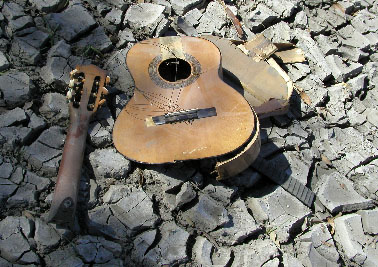
Some time passed and I called Bruce, making arrangements to stop by and have a look at his guitar. When I arrived at the house, Bruce proudly showed me the old instrument. From what we have been able to determine it was built in approximately 1954. What strings were left were all rusty and some of the frets were worn down completely. There were two large cracks on either side of the sound hole where the spruce top had completely caved in. It seemed that Bruce was a bit of a closet picker and had purchased the guitar decades before. He told me that in an earlier life he and his pals would sit around a fire, drink a few brewskies and sing and play until the wee hours of the morning. They would always end their night of revelry with the singing of Amazing Grace. As it happened, one night someone had drunk one too many, tripped and fell right on top of Bruce's guitar, rendering the fine instrument relatively useless. The guitar looked more like a giant spoon. I asked him what he intended to do with the guitar and he said he wasn't sure. Then he said some words that were music to my ears. "Steve, if you can use this guitar for good and positive purposes, you can have it." Humbled, I thanked Bruce for his kindness and bid him good day.

I returned to the studio with the guitar and presented it to my colleague, Eldon Winter. Eldon could make a cigar box guitar sound good and I figured he would be the right guy to make an initial evaluation of the guitar. He tuned up the remaining strings on the guitar and played a chord. There was magic in the room. In that instant we both knew that there was something very special about the guitar. Even in its battered and broken state, there was a musicality about the instrument that was so warm and inviting. We knew we had a keeper, the question now was how could we get the guitar fixed, so we could actually use it in the studio for recording.

A fine luthier friend of mine, Jake Peters, (http://www.jakepeters.ca) was called on to help in the decision. Jake is not only a expert builder of string instruments, but a champion banjo player as well. (you may insert banjo jokes here!) He took the guitar back to his shop to make an assessment and report back to me on his findings. Several weeks later, Jake phoned with the news. To properly restore the guitar to its original look and condition would costs several thousand dollars. I told Jake that I just didn't think that would be possible, but thanked him for his time. He then mentioned if it wasn't really a cosmetic restoration that we wanted, he could do a structural repair, adjust the neck, and give the instrument a new set of frets. He said there would be no difference in the playability or sound of the instrument, it just wouldn't look as pretty. For around eight hundred dollars, he said we could be in business and have a very usable guitar. I told him to go ahead and that I trusted his judgement. "Don't worry about how it looks, just worry about how it sounds", I told him.

The day finally arrived when Jake came to the studio to deliver the guitar. I could tell by the cheshire grin on his face that he knew we had something very special. He handed the guitar to Eldon. The sound that poured out of that guitar was jaw dropping! The guitar still bore the scratches, scuffs and scars of its previous life, but it was now solidly repaired and ready to make beautiful music once again. Sounds from that guitar have graced many of the albums I have been privileged to work on since that day. It has become our "go to" acoustic guitar in the studio. Recordings from Starfield, Jaylene Johnson, Matt Brouwer, Jill Paquette, Jake, Brian Doerksen and many others, bear the imprint of that instrument.

As we begin the New Year, I have reflected on the story of the old Gibson guitar and realized that we are all broken.

Like Bob Dylan sings in his classic song:

"Broken hands on broken ploughs
Broken treaties, broken vows
Broken pipes, broken tools
People bending broken rules
Hound dog howling, bullfrog croaking
Everything is broken"

Each of us has experienced pain, loss, hurt, loneliness, betrayal and the list goes on. Like the old beat up guitar, many of us have suffered some pretty deep wounds and scars. The good news is that there is hope. Hope for healing, forgiveness, restoration and peace. Hope for another day. Every one of us can be patched up and make useful, beautiful music once again.

As I ponder the past year, I am thankful for Mr. Gibson and at least one good banker!

www.prairieboy.com
© 2011 Stephen J. Rendall - All rights reserved.

Wednesday, July 20, 2011

POISON PEN


Each year when Christmas came around my mother played the role of part time Santa, part-time Mother Teresa. She took on the monumental task of making sure that, as it seemed to me at the time, half the town had a present under their tree from the Rendalls. These were not particularly exotic, expensive presents, but rather a token of her love. One year, it might have been a candle or decorated soaps which she had made. Another year it may have been a special food item. She would individually wrap hundreds of gifts for neighbors, friends, families, married students, the senior's organization and many others. My brother Dave and I were called on to act as "Santa's helpers" and were enlisted to help make deliveries.

One house I was usually dispatched to was directly across the street. The small house couldn't have been more than 400 square feet and was always neatly kept. I was very fearful of the particular tenants of this house, especially the man. Not because he was part of a gang or the toughest guy in town. He wasn't a particularly big or strong man. Yet I knew he had a weapon. Not a knife or gun, not even a sling shot. The weapon he wielded was a pen . . . a poisonous one.

Tom Brannan and his wife lived in the small house across the street and had moved to Three Hills to enroll their kids in the high school at Prairie. There was some kind of disagreement with the administration over a disciplinary action involving one of his children and Tom really let this get under his skin. Quite frankly he became bitter. This little seed of bitterness grew into an entire root system that choked out life. He began to turn his anger into letter writing. A gifted man and former preacher, he was never at a loss for words. Over the years he wrote dozens and dozens of letters to the local paper and individual leaders at the school. He attacked L.E. Maxwell, my Father and others in his rants. He had not only taken a bitter pill, he had swallowed the whole bottle. Venom and bile spewed from his pen like Mount Vesuvius. Poisonous darts aimed at hurting and causing pain were lobbed in the direction of any and all that he felt had wronged him or his family in some way. He attacked with a vengeance that would have made William Wallace proud. This "cause" absolutely consumed him. He thought of little else and really had no life outside of this obsession. No friends, no real activities, just a very sad life. As is often the case in small towns, the rumors swirled and Tom became a larger than life figure as people went out of their way to avoid him on the streets and in the shops, fearful that he might turn his weapon on them. Looking like something from an aggressive political campaign, even his lawn was dotted with small stakes sporting placards denouncing his great displeasure with Prairie.

So there I was, every Christmas, standing on the step of that tiny house, knocking on the door, gift in hand. Usually it was Mrs. that came to the door, but occasionally "he" would answer. I would hand over the package, wish them a Merry Christmas and scoot back across the street, heart pounding with fear that I might just get shot at any moment. Safely inside, I would take some time to recover before Mom would send me on to the next delivery. Mom and Dad always greeted the Brannans with a cheery hello as they would pass them on the sidewalk or see them out working in their yard. They treated them like neighbors and never shunned them in any way.

Many years passed, the letters continued to be written and at some point, Mrs. Brannan passed away. Well into his eighties, the loss of his wife only made matters worse as it gave Tom more time to focus on the wrongs which he felt had been done. One of our good family friends had also befriended the Brannans and she made a consistent effort to stay in touch with him after his wife died. One day she was over at his house for a visit when he began to break down and lament the horrible things he had written and said about the school over the many years. He said he had been doing a lot of thinking about his life and wondered what he should do. Our friend kindly suggested that they call my Dad and he would know what to do. Dad went over to the house and met with Tom. He sensed a completely different man and so offered a suggestion. "Would you like an opportunity to address the entire church after my sermon on Sunday?", Dad asked him. "You would really allow me to do that?", Tom replied. "Of course", Dad said.

Arrangements were made for Tom to be in church that next Sunday morning. After Dad was done preaching he called Tom up to the pulpit. As he made his way forward every eye focused on the "monster of Three Hills". Dad spoke to the congregation and said, "Mr. Brannan has something he would like to say", and then moved over and stood right beside him. The tears began before he even started speaking. Dad put his arm around his shoulder as he stood there sobbing, his entire frame shaking. With a quavering voice hardly understandable at times, Tom apologized for the hurt he had caused so many for so long. You could have heard a pin drop in that tabernacle. When Tom was done Dad took the microphone and addressed the congregation. He sincerely thanked Tom for having the courage to stand up and say what he had just said. He accepted his apology and then he did what I thought was the most compassionate thing. He invited any of the congregation who wanted to come forward to show their support and forgiveness of Tom to do so. Dozens of people got up out of their seats and came up on the platform. Forming a semi circle around Tom, Dad said a prayer. When he was finished, folk lined up to hug this man and shake his hand. You could see the transformation on Tom's face as the burdens of bitterness, piled up over many, many years, began to slide away.

As I have reflected on this story in recent years, I am struck by three things.

The first is that bitterness not dealt with will grow and destroy. As Rhianna sings in her song, Disturbia:

"It's a thief in the night
To come and grab you
It can creep up inside you
And consume you
A disease of the mind
It can control you"

The second is that it is never too late and we are never too old to say, "I'm sorry", admit our wrongdoing and ask for forgiveness.

The third is that as community we need to be willing to offer up forgiveness and restoration and not let our bitterness and cynicism about someone else's bitterness stand in the way.

From that day on, Tom began attending church and would sit right up at the front. After church, Dad would barely be in the door and get his coat off, when the phone would ring. It would be Tom from across the street with a word of encouragement on how much he enjoyed the sermon that day.

The poison pen had been put away. . . it had run out of ink.

www.prairieboy.com
© 2011 Stephen J. Rendall - All rights reserved.

Thursday, May 5, 2011

THANK YOU!

I want to again say a big thank you to each one of you for reading my blog. For those of you who have left comments, sent me emails, and called, I am humbled and truly grateful. What started out to be some storytelling encouraged by my family is turning out to be something that is being used to bring hope, healing and a few laughs to more people than I could ever have imagined. I had no idea that the stories would resonate like they have. I wish I had time to write each of you individually and thank you.

I have identified between 75 to 100 stories I think are worth telling from the first 20 years of my life. I am in the process of putting these into a book form which will include more pictures and some other surprises. If you have ideas or can help jog my memory on a story or two I would be most indebted.

You can contact me at: sjrendall@gmail.com

For clarity sake there is an index on the right hand side that lists the stories, just click on those and read on!

Blessings - SjR

www.prairieboy.com

Friday, January 14, 2011

WRITING ON THE WALL

In August 1965, when Howard Crane packed up his earthly belongings and headed to the western plains of Canada, I'm sure he had no idea what his life would have in store. The Cranes lived in Wellsburg, NY, a small town right on the Pennsylvania border. Together with his wife and four children, Howie traveled in their 1956 Chevy for five solid days to arrive at the school. Big changes awaited the family, but they were able to settle in and slowly assimilate into Prairie life.

Howie had trained as a tool and die maker and upon hearing of the need for another machinist at the school he responded. Having had some previous connection, as his youngest brother had attended Prairie High School and his sister had attended the college, he was somewhat familiar with the school. Later on his mother served on staff, working in the Prairie Bookroom. Prairie President L.E Maxwell had also shared the work of the school in the Crane's church and so it was not a complete culture shock when they arrived on campus.

For the first few years Howie worked with Mr. Zweifel or "Pa" as we knew him. Pa was from Switzerland and was a highly trained machinist in his own right. The Zweifels were our neighbors when we lived on Prairie Crescent and in the winter I would often see Pa on his cross country skis coming home from work. He also loved the mountains and made many trips to Banff and area for hiking and climbing.

You may wonder why Prairie needed two machinists but let me assure you that these "behind the scenes" workers kept the place alive and humming. Parts were machined for literally every department on the campus, from the garage to the electronics department. I remember when I was doing student work in the recording studio and we needed a bearing or some other part to keep the old tube Ampex tape recorders rolling, we would pay a little visit to the machine shop. Many of us wondered if there was anything these two couldn't make!

Prairie had a fascinating potpourri of shops. It was enough to give a young boy ADD. Every time you opened a door you would discover a new piece of machinery or someone hard at work on a project. Many a staff kid was the recipient of this unique gift. I remember times when Mom would have to deliver the little red Ford Falcon to the garage for an oil change or to have the winter tires put on and I would duck into the many shops in that area of campus. John Hamm and later Forest Cummings were right next door, always in the middle of a spark show. They ran the welding shop. We would take our broken bikes to them in the hopes that maybe the front forks could be fixed one more time. We invented "offroading" before it was popular! On some of these trips I would visit the machine shop, home of Howie Crane and Pa Zweifel.

Entering the door to the shop opened up an entire new world. Howie would greet us with a big smile and a twinkle in his eyes. Wearing a blue shop apron and clear eye protectors, he would welcome us to his place of service. Large metal lathes, milling machines and drill presses were strategically placed around the shop. Small tools of a precise nature were also important. Punches, scribers, tap wrenches and micrometers were the instruments with which these two men implemented their craft. But there was one fixture that had nothing to do with machining and everything to do with people . . . measuring people.

On one side of the shop was a dedicated wall where Howie would measure every visitor who was willing to stand against it - heels in, shoulders back, chin out. Howie would get his stainless steel ruler from his desk and placing it on our heads he would carefully mark a small line on the wall and write our names and the date. As the years went by hundreds of staff kids were measured on this wall in many colors of ink and pencil. A real work of art. It was fascinating to watch the growth of not only yourself but also your friends. Howie always engaged us in meaningful conversation as he patiently went about the documenting of our heights. I have often said I wished Prairie had been able to preserve that section of the wall for the museum, because of the enormous human element attached to it.

In a recent note from his oldest daughter Gil, she shared the following memories: "We kids used to hang out at the machine shop when we could. I would sweep the shop for him and clean the sink. With the dime he would give me, I would go to the Staff Store for a box of Smarties to share with him. Dad had a big metal block with different sized holes in it, and a box of various sized screws - a puzzle block. I would try to fill as many holes as I could with screws. A wonderful way to keep a child busy. It was always fascinating to watch him create parts for various machines on the variety of lathes. He taught me how to use vernier calipers. He was amazingly particular, down to thousands of an inch, incredibly precise, always calm and patient. Even as a young child I realized that he was of amazing character."

Sometimes it is the seemingly little things that we do that can have long term impact. Howie's soft spoken demeanor and thoughtful care for people won him friends young and old, many who are still in touch with him to this day. Thanks to Howie we also began a wall at our home when we were kids. Dad would measure us up against the cinder block wall of the Crescent house. When Cathy and I got married and had children we carried on the tradition. From our kids to their friends and visitors, sometimes even pets, all were logged on the wall. When we sold our last house in Three Hills, my Aunt Lois painstakingly transcribed every line off the wall to a long sheet of paper to be copied over to a new wall.

So if you come over for a visit and you see me fetching a pencil and a ruler, you had better measure up!

www.prairieboy.com

© 2011 Stephen J. Rendall - All rights reserved.

Wednesday, January 12, 2011

AMAZING GRACE AND ROCK 'N' ROLL

I will never forget the day my Dad showed up with a new stereo. This particular model was housed in a nice wooden cabinet with separate speakers and bore a gold embossed logo - Silvertone. Just the name alone conjured up mystery and stirred my imagination. This meant two things - that our family would now be able to enjoy listening in stereo with a much higher fidelity then we had previously and that my brother and I would be the recipients of the old mono suitcase phonograph player.

Dad proudly set up the new stereo in front of the big picture window in the living room of our little house. He placed the unit on a large wooden stand with room for storage of LP's down below and spaced the two speakers out on either side. Our new stereo system had a stacking mechanism allowing for the placement of a half dozen or so LP's on it. One record would finish and another would drop and they would play in sequence. This feature made the player almost like a small home jukebox. I'm pretty sure the scratches inflicted on these vinyl records falling on top of each other was quite damaging, but nobody thought of that at the time. Dad was very careful with his record collection, making sure that he held them with his thumb on the edge and a finger in the middle, so as not to get any fingerprints on the vinyl itself. He had a small cleaning kit which he used to remove dust with the velvet roller. Each and every record promptly went back in its proper sleeve and dust jacket. When Dad placed a record on the machine the glorious sounds of stereo filled the room. It might not have been heaven, but maybe it was a little taste?

Outside of books, Dad loved his records and collecting music. He would frequently come home from the Prairie Bookroom with the latest titles by Rudy Atwood, The Sixteen Singing Men, Tennessee Ernie Ford and a host of others. Christmas music was also important in our home and every Christmas a few more albums were added to the collection. Classics like Bing Crosby and Perry Como were brought home for us to enjoy. The Bookroom's strict music policies seemed to be more relaxed with Christmas music and a lot of "worldly" holiday music managed to sneak its way in the door. One of my Aunts, I'll call her Rachel, because that is her name, kept several of her records at our house so as not to incur any displeasure from Grandpa and Grandma. What better place to store them than at the house of her older sister who was married to a preacher! The original Sound Of Music soundtrack, featuring the clear voice of Julie Andrews and a sampler record that included Patti Page singing How Much Is That Doggie in the Window?, were a couple of the titles I recall.


Dave and I placed the little mono record player in our room and would listen for hours to the various story and song LP's that Dad would buy for us. We enjoyed Black Beauty, Seven at One Blow, Dick Whittington's Cat and a variety of Bible stories. Many nights we would fall asleep while the records played and Mom or Dad would come into our room, lift the needle off the player and shut off the machine. I remember Dad buying the soundtrack to Chitty Chitty Bang Bang long before we had ever seen the movie. As we would listen, our imaginations would fill in the scenes and action and in effect, create our own movie.

Dad, being the loyal Scot that he was, loved the bagpipes and had a few LP's of various pipe bands. Our family had experienced and enjoyed one of the largest drum and pipe festivals in the world when we visited Edinburgh in 1970. Each band, dressed in their kilts with tartans representing the various clans, cut a colorful swath across the vast lawns of Princess Street Gardens at the foot of Edinburgh Castle. Yelling out terse commands, the drum major led the group, holding a highly polished mace in his hands. One of the other highlights of that summer was being able to attend the Royal Edinburgh Military Tattoo. This is an annual series of military tattoos performed by British Armed Forces, Commonwealth and international military bands and display teams. The event takes place annually throughout August, as part of the wider Edinburgh Festival.

A recent article in the Edinburgh Castle paper describes the event this way:

"In the glowing twilight, the floodlit Edinburgh Castle draws all eyes, a hush falls and darkness deepens. Then the great oak gates of Edinburgh Castle sweep open, and the swelling sound of hundreds of pipes and drums cracks through the night sky. Emotions run high: the Edinburgh Military Tattoo unfailingly enthrals, symbolising the Scotland that everyone holds dear in their heart.

Now a dazzling show is spread out on the Castle Esplanade, a whirling and colourful kaleidoscope of music, dance and display. It may be exciting - daredevil motorcycles at speed and the breathtaking re-enactment of battles, or exotic - Turkish music and Chinese dancers, or simply the best of Scottish - Highland dancers wheeling and swirling to a fiddle orchestra.

Then the audience gather themselves together for the finale of the Edinburgh Military Tattoo. All 1000 or so performers on the Castle Esplanade, column after column of marchers, dancers and bandsmen. The Tattoo audience joins in a great chorus of singing, cheering, and applause; cries of 'Bravo!' before a hush falls for the singing of the Evening Hymn, the sounding of the Last Post and the lowering of the flags on the Castle.

Finally, all faces turn to the Edinburgh Castle ramparts, where a single spotlight cues the Lone Piper of the Edinburgh Military Tattoo to play his haunting lament, the high notes echoing across the still night sky and over the dark Edinburgh skyline, as the flames of the Castle torch lights and the piper's warming brazier flicker and slowly die.

At the Edinburgh Military Tattoo fireworks burst out from the Castle against the black sky, but the spell is not broken, for when the crowd sing Auld Lang Syne and shake their neighbour's hand, the emotions linger, and the heart is full. Goers to The Edinburgh Military Tattoo all united in international friendship, the shared love of Scotland, its music and its traditions."


As the fog rolled in from the sea and the sound of the pipes echoed throughout the castle and across the city, it became an unforgettable experience for our family.

I'm not sure which is more maligned - the bagpipes, the banjo or the violin, but the bagpipes certainly receive their fair share of jesting. It is said that the Irish sent the bagpipes over to Scotland as a joke . . . and the Scots still haven't caught on! Alfred Hitchcock once said, "I understand the inventor of the bagpipes was inspired when he saw a man carrying an indignant, asthmatic pig under his arm. Unfortunately, the man-made object never equaled the purity of sound achieved by the pig". A friend of mine once asked me what the definition of a gentleman was. The answer, he claimed, was a person who knows how to play the bagpipes but doesn't.

A friend of Dad's knew he was a big bagpipe fan and presented him with a small gift. It was a 45 record with a bright orange label in the center housed in a plain white paper sleeve. The 45, was another musical reproduction device in a line of many, starting with wire recordings, wax cylinders, 78's and 33 1/3 LP's, to name a few. The 45 had a large hole in the center necessitating the use of a little plastic adapter to enable it to be played on standard phonograph machines. For many years this became the medium of choice for the record companies to service radio stations, hence the name "single", as only one song appeared on either side. Record stores would also sell them and I collected many throughout my high school years.

The title of Dad's gift was the classic recording of "Amazing Grace" by the combined bands of the Royal Scots Dragoon Guards. This recording had reached number one status in the charts in the United Kingdom, Ireland, Australia, Canada and South Africa. The recording was originally released in 1971 to mark the amalgamation of the Royal Scots Greys and the 3rd Carabiniers, to become the Royal Scots Dragoon Guards, Scotland's only cavalry regiment. The album first appeared on the RCA label and it was this recording which gained the band's world renowned fame, selling over 6 million copies of the tune when it was released as a 45.

Being the curious kid that I was, I decided to check out the B side of the little black vinyl 45. On this particular edition, the distributor of the single, had decided to put an unrelated group on the opposite side of Amazing Grace. What met my ears were the heavy sounds of a rock band a la Deep Purple or T. Rex . This was a brand new sound to me. The punchy drums and powerful guitars were something I thought I could get used to! As the song says, "It's Only Rock 'n Roll, But I Like It".

Occasionally, when we arrived home from school, Mom would have left a note on the table or door letting us know that she would be right home. Sometimes she would be called out on church business or be off on a project or committee meeting. We were pretty independent and would make ourselves a sandwich, grab an apple or some cookies and go outside to play or listen to the stereo.

Every Saturday morning the Institute held a weekly staff meeting. Attendance was mandatory for both staff men and women. To aid in this endeavor, the school provided a babysitting service. Bible school girls were assigned to different homes as part of their student work. The girl would arrive just before 8 o'clock and leave right at 9. Many times Mom and Dad would visit with other staff and wouldn't arrive home until 9:30 or so.

After the discovery of this new musical art form, I decided that a scientific experiment was in order - one along the lines of acoustic research. Taking advantage of the small time window when the babysitter left and my parents weren't yet home, I hauled both of the speakers from Dad's stereo into the front doorway and stacked them up one on top of each other. Pointing them in the direction of the elementary school, I enlisted my brother as my research assistant. I cranked up the B side of that little 45 and then dispatched Dave to walk down towards the school and see just how far he could hear the music. I kept an eye out for Mom and Dad or an annoyed neighbor or two. Evidently the stereo put out quite a healthy decibel level, because on Dave's return, he reported that he could hear the music all the way down at the elementary school. I'm sure that the noise emitting at that level was completely distorted, but it brought me a great deal of satisfaction that I had effectively "covered" the neighborhood with my gift. Working quickly, we had the whole thing put back in its place, playing the sweet sounds of the Sixteen Singing Men upon Mom and Dad's return. I don't think any neighbor ever reported us to our parents nor did any of them call the cops. They were probably all at Staff Meeting as well.

Every time I hear the haunting strains of the bagpipes, I smile to myself and think of the day I found Amazing Grace and discovered Rock 'n' Roll.

www.prairieboy.com


© 2011 Stephen J. Rendall - All rights reserved.

Friday, December 31, 2010

PAIN IN THE BUTT!


I first met Jim Bishop, Sr. when I was in high school. The Bishop farm was located several miles south and east of town. Jim would hire groups of young guys for some chickin' pickin'. (No, this was not some type of guitar jam!) We showed up at the Bishop farm around midnight on the chosen night and, for several hours, stuff mostly live chickens into crates and load them onto semi trailers. We entered the pitch black barn and by crouching low and feeling for legs, we would gather 10 or 12 birds at a time depending on the size of the chicken, and head out to the truck, place them in a crate and return for more of the same. The Bishops provided a lunch about halfway through the night and then we worked until the wee hours of the morning when the job was complete and thousands of the white creatures were safely in their crates.

The job was quite horrible, even foul, as we sloshed around in a great deal of chicken poop, the strong smell of ammonia burning our nostrils. A lot of the guys wore gloves, but I never felt comfortable doing that as I couldn't feel how many legs were in my hands with gloves on. So barehanded I went and the resulting scratches, pecks and cuts would be a colorful reminder the next morning of the lengths we would go to earn some pocket money. The birds were never very comfortable with their impending destiny and fought and struggled for their freedom. In later years we were replaced by professional crews that would travel from farm to farm loading the trucks. I'm sure these crews were not only faster, but I guarantee the mortality rate of the fowl went up.

Jim was very involved in cloud seeding. Cloud seeding is the attempt to change the amount or type of precipitation that falls from the clouds. This is commonly done by dispersing substances into the air that serve as cloud condensation, which alter the microphysical processes within the cloud. The intent is to increase precipitation (rain or snow), but hail and fog suppression are also widely practiced at airports. As a farmer, Jim was very interested in the reduction of hail, as many an Alberta farmer has lost their crop to this menace of mother nature. From time to time his articles, extolling the virtues of this technology, would appear in the Three Hills Capital, our local paper.

In the summer of 1979 Jim decided it was time to build a new barn and hired several high school guys along with his sons, Jim Jr., Frank and Roy to help with the construction of his new edifice. I spent several weeks working on the project and my brother Dave stayed on for the entire summer. The barn was sided with a heavy gauge metal siding. This was applied with a long ring nail delivered by power nailers. These nail guns were powered by .22 calibre gun ammunition and packed quite a punch.

One evening, our family was invited out for supper to the George McPherson's. This particular day, Mom had set the supper time a little later knowing that my brother would be coming home from work and would need to shower and clean up. Dave arrived home and Mom encouraged him to hurry as she wanted us to be on time. When Dave came up from his shower, he held in his hand one of the 3 inch ring nails. Most notably with this particular nail was that there was blood up its entire length. With a slight grin on his face, he explained to us that as he had gone to remove his jeans to take a shower, he couldn't get them pulled down. They were nailed on! Nailed right into his derriere. He had pulled out the offending object and continued on about his business. Mom, a little incredulous at this tale, questioned him as to what had happened. He said that earlier in the day, he had felt a slight bit of discomfort as one of the other workers had bumped into him with his nail gun while they were up on the scaffold. Evidently, the gun had fired a nail and it had found its target.

Dave has an incredibly high pain tolerance and I can assure you that if that had happened to me, I would have yelped to high heaven and been off to emergency in a New York minute. He thought the discomfort was just from being bumped by the gun and went on with his day. Mom freaked out. She insisted that he go next door immediately to our neighbor, Dr. Ying, and get a tetanus shot. Dave went over, was given the shot and suffered no after effects. Miraculously the nail had missed any bones.

Dave still has the offending nail in a clear plastic pill bottle - a reminder of the day it was a real pain in his butt.


www.prairieboy.com

© 2010 Stephen J. Rendall - All rights reserved

Monday, December 20, 2010

SHARP AS NAILS

When I was growing up, the IDA drugstore in town was right up there on my list of favorite places. Not because of the toothpaste, deodorant, candy or even the drugs, it was because of the music. Before there was itunes, MP3's, Limewire, CD's, minidiscs, cassettes, or even 8 tracks, there were LP's. The store had a very large section of Long Play records and I knew exactly what they had, what they should have and what I thought I wanted.

Prairie Bookroom had extremely strict policies on what it would carry and by diligently guarding the flock from this type of worldly influence they provided no option for those interested in other types of music. John Toplensky, the proprietor of IDA, had carved out a very nice niche market in the selling of Contemporary Christian Music or CCM as it is called. John carried some secular music, but focused primarily on CCM as distributed by WORD Canada.

I saw no reason why the secular couldn't live in harmony with the sacred and so I would eagerly await the arrival of the latest releases. Albums by Love Song, Daniel Amos, Phil Keaggy, 2nd Chapter of Acts or Keith Green would quite happily co-exist in my collection alongside the Eagles, April Wine, Alan Parsons, Chilliwack, Joe Walsh and many other titles. I would be there waiting the day a new shipment arrived. John would let me special order LP's that he wasn't planning on stocking. He also began to bring in recording magazines of which I couldn't seem to get enough of. The WORD rep would come to town and hold "listening parties" of the latest music and hand out prize packs of singles, promo flats, etc. This effectively fueled my fire.

Back in the day, WORD ran a coupon program with stickers placed on all of their LP's and cassettes. If you bought 3, you would get one free, but later that program moved to buy 4 and then buy 5 and then eventually was done away with all together. The coupons were stuck to the outside of the shrink-wrap and on occasion WORD would "double coupon" in order to incentivize the buyer. I would carefully save up my coupons waiting to use them on just the right title. I always bought the vinyl, feeling that the cassettes were too low quality and thinking of myself as quite the little audiophile. I loved the LP jackets with all the liner notes, lyrics, pictures and large artwork. In my mind the absence of these extras is one of the great losses in the new digital delivery world we live in.

Over the years I became as familiar with the music inventory in the store as John himself or maybe even more so. I had started noticing that many of the LP's were missing their coupons. There were holes in the cellophane where they should have been. It looked like someone had taken a little exacto knife and just cut a neat square around each one. I talked to John about this and he didn't seem to have any idea where the missing stickers were wandering off to. This was before closed circuit TV became popular.

Several weeks later as I was perusing the stacks of LP's, I noticed a most curious sight. Right beside me was a middle aged woman from the community. This lady and her husband owned a business in town and were very upstanding citizens. As she would flip an album forward, I could see her take the nail of her index finger and jab it down into the cellophane behind the coupon. Quickly, she worked her long, sharpened fingernail all the way around the coupon, pocketing it and moving on to the next one. I was shocked to say the least! She was very focused and by the efficiency of the act, looked like she had done this a time or two before. To this day I am not sure why she didn't notice me or seem to care if anyone was watching her, but she was making quite a haul. I wasn't really sure what to do, being only 14 or 15 at the time. I should have said, "Hey, Mrs. so and so, what do you think you're doing?", or something to that effect, but I didn't. I walked to the back of the store and found John. After telling him what had happened, he assured me that he would keep an eye out for this woman. Some time later I was visiting with him and he mentioned that he had caught her doing exactly what I had described. He confronted the lady and the coupons stopped disappearing.

In later years, as I visited with many store owners, I was told that Bibles and Christian music are some of the most stolen items in stores. Since that time, I have never looked at long fingernails the same!


www.prairieboy.com

© 2010 Stephen J. Rendall - All rights reserved.

Friday, May 21, 2010

TASTE OF HONEY IN THE FIRES OF HELL

Albert Kitts was, in the words of my father, a "mountain of a man", the type with the build of a middle linebacker with no neck. Kitts, of Dutch extraction, wound up moving to Prairie sometime in the early 60's. He performed manual labor working on the farm and the construction crew. With an accent as thick as molasses, Albert was tall, broad shouldered and strong as an ox. Unfortunately, Albert was mentally unstable which caused serious problems throughout his life.

In the spring of 1982, Albert took it on himself to move back to Three Hills and take up residence in W dorm. This dormitory housed the single staff men. Those characters were material enough for a whole book in themselves. Men like George Bryant who hailed from Georgia. A very large man and bald as a peanut, we affectionately dubbed him "chrome dome". George had a typical southern drawl and was employed as a High School study hall supervisor, where with some creative gift giving of cakes and cookies, one could buy their freedom from said prison.

Earl Latimer was an odd duck who had one room of his little two room apartment chock full of tape recorders, turntables and a sizable record collection. Earl would copy LP after LP and give the cassettes to staff and visiting missionaries, "sharing" his wonderful library with the larger world. This was long before file sharing and downloading was to become an issue. Little did the artists know that in a little town in Alberta, bootlegging ran rampant. Earl could be very gruff and curmudgeonly, but underneath his tough exterior beat a kind heart.

Paul Koch was a small German man who worked on the maintenance crew shoveling snow in the winter and weeding flower beds in the spring and summer. In the dead of winter Paul would be up long before the dawn. Armed with his pick axe, shovels and wheelbarrow, he would make sure that the core campus was free of snow and ice insuring staff and students would be safe from injury should they slip and fall. Paul was a faithful servant who lived an extremely simple life and had very little for himself. With his German accent and a twinkle in his eye, Paul loved the students and they loved him. One day in his older years Paul mysteriously disappeared and no one had any idea where he had gone. He was found several days later face down in one of the boiler plant's reservoir ponds. He had his wheelbarrow and scythe with him and the conclusion that was reached was that he had a heart attack while weeding around the ponds and slipped into the water.

Sid Langley was also a resident of W dorm and anyone who ever met Sid was lucky to have gotten away. Sid could talk the hind leg off a donkey. Sid worked in various jobs at the school and did stints in the Bookroom, nightwatch and maintenance. One summer when I was in High School, I traveled back and forth to Camp Silversides several times with Sid. He was brave enough to let me drive his car which I thoroughly enjoyed.

The problem with Albert moving in to W dorm, was that he was not invited, nor did he have permission to live there. Albert just moved in lock, stock and barrel. He felt that it was his "right" to live there having worked for the school back in the 60's. His presence struck fear into the residents and rightly so; they were very concerned about their new house guest. Big George Bryant was so scared that he took to sleeping in his station wagon at night. Some of the other guys would bar their doors, while others had a hard time sleeping. Clearly something needed to be done. That "something" fell to my father who was a vice president at the school.

Dad had several encounters over the years with Albert. Occasionally during a church service Albert would stand up and start yelling out a bizarre concoction of verses, doomsday prophesies and general hatred and venom directed at the staff and administration of the school. It turns out that when Albert had been working for the school in the 60's, his employment was terminated due to his violent temper and his inability to get along with his fellow employees and leadership at the institute. Evidently Albert hadn't remembered the "forgive and forget" part and was back to make his presence felt.

Because of Albert's history, Dad wisely chose to take another of the vice presidents with him to chat with Albert about his living in W dorm. They made him aware of the fact that he was not really welcome to stay. To say the least, this news was not welcomed by Albert. Dad and his partner took their leave, not really sure what step to take next outside of calling in the authorities. Clearly something needed to be done as his presence in the dorm was causing a great deal of discomfort and inconvenience to the residents. Dad decided to leave it to the next day when the administration would meet and determine the next course of action.

Mom was a fairly accomplished author and had released a book entitled "Just A Taste Of Honey" in 1976. This book, published by Moody Press of Chicago, IL, featured short articles from Mom's life with a brief application at the end of each story. This was the first of Mom's four books along with dozens of articles that she wrote for the Prairie Overcomer. Just A Taste Of Honey went on to sell over one hundred thousand copies making it a best seller.

One sunny afternoon in the spring of 1982, the front door bell rang at Mom and Dad's house. Dad was at work and Mom was lying on the couch in the front room. After coming down with MS in 1976, she spent a great deal of time on the couch in the living room. Mom could still walk, albeit in an awkward teetering way, and she made her way to the front door. Upon opening the door, she saw Albert Kitts standing there, red faced and clearly agitated. Mom was frozen and scared. She had not seen Albert in years, but knew from Dad that he was back in town. Nervously, Mom reached out to the screen door, quietly locking it as she asked Albert how she could be of help. In one quick motion, Albert produced a copy of her book and yelled at my Mother in his thick Dutch accent, "May you have a taste of honey in the fires of hell!". With that he ripped the book completely in half and threw it down on the front stairs. He didn't just rip it down the spine, he ripped the book sideways. Mom, imagining those large strong hands ripping the screen door down and grabbing her throat, was shaking like a leaf. Albert, without saying another word, turned around, marched back down the stairs and left the yard. Mom collapsed on the floor her rubbery legs refusing to hold her up any longer.

After she regained her composure and some of her strength, she was able to get over to the telephone and call my Dad. He came home and was able to comfort Mom and get her comfortable. Later that afternoon, a call was made to the authorities and Albert was no longer a resident of W dorm.

www.prairieboy.com

© 2010 Stephen J. Rendall - All rights reserved.

Sunday, April 25, 2010

STRIPPER WANTED

Back in it's heyday, Prairie was a vertically integrated organization that understood economy of scale better than most. This was long before these terms were commonly used in the business fabric of today. One of those vertically integrated areas was the Graphics and Printing Department. A host of sub-departments such as the print shop, art, pre-press, photography and mailing were all under this umbrella. This structure handled all of the printing needs for the schools in addition to printing and distributing three or four magazines.

Printing had been a long tradition at Prairie, starting sometime in the 1930's with lead type machines and ending in the 1990's with high-tech Heidelberg colour presses straight from Germany. It is interesting to note that PBI acquired their first press from a disposal sale of seized property. The press in question had actually been used to print counterfeit money!

Employing twenty to thirty people at it's peak, there always seem to be a need for qualified workers in the printing department. Advertisements for these job openings were placed in various magazines, brochures and newsletters that the school would print and distribute. There were a number of American citizens on staff and the personnel department would assist these folk with their visas and immigration documents to allow them to move to and work in Canada. Many of the border officials in Washington, Idaho, Montana and North Dakota became familiar over the years with not only the name of the school, but some of the individual staff members and students as well. There was a constant flow of students and staff and usually the officers were quite cooperative and civil, making for an easier transition back and forth.

My friend Harold Leo graduated from the school in the '70's, moved back to the United States, married and settled down. Harold was made aware of a need in the pre-press department at the school and so applied for the job and was accepted. I count it a great privilege to have worked with Harold during the Harvest Music label era. You won't find a more conscientious and hard worker than Harold. With all their worldly belongings in tow, Harold and his wife Debbie headed off to Canada. At the border they were asked to produce their paperwork, including the letter of acceptance from the school, for the job in question. Normally this process could be quite lengthy, so they braced for the worst. Harold handed the officer the letter and waited for her response. Looking up, the officer said, "What the @#$% does a Bible school need a stripper for?" On the letter it said that Harold was being accepted at the school in the position of stripper! After reviewing the documents, the border guard finished her interview and with a wry smile, looked at Harold and said, "Well, if PBI wants a male stripper they can have you. Get out of here!" The whole process had taken no more than fifteen minutes.

For those unfamiliar with the terms used in the printing business, back in the dark ages and well into the '90's, pre-press specialists were commonly called ... strippers. The job of a stripper was to photograph galleys and piece together, or "strip", the film so press plates could be burned. They would work with negatives, film and plates to make sure the finished printing job was accurate and in proper register. The personnel department had simply used the term popular at that time for this position and had inserted it into the letter of acceptance. Harold quickly explained that it would not be him who would be doing the stripping. Well, actually it would be him stripping, but a different type than the officer was thinking of. He then explained a bit about the job. I'm sure the customs officers had a good chuckle over that for weeks to follow.
www.prairieboy.com

© 2010 Stephen J. Rendall - All rights reserved.
Friday, April 16, 2010

ESCAPE FROM ALCATRAZ

It was a beautiful spring day in 1979 and perfect for a road trip to Calgary. Phil Callaway, Dave Adkins, Brent Austring and I got an early start so we could pack in a full day. Typically, we had a little "circuit" on these trips to Calgary and that day was no exception. We would check out Keencraft Music, the largest music store in town. There we would gaze longingly at the guitars, drums and recording equipment. We would wander the aisles of A&B records on the Eighth Avenue Mall and maybe buy the latest LP or a 45 single. We might take in a movie and for sure we would stop at Peter's Drive-In for their famous burgers and shakes. Checking the paper, we all agreed on a movie we should view. Being Clint Eastwood fans, it was natural for us to see his latest movie, Escape From Alcatraz. We decided on the afternoon matinee which would save us a few bucks. A few bucks, as it turned out, that we would need!

We headed off to the Palace Theatre on Eighth Avenue. The Palace Theatre was one of those grand old buildings with chandeliers, small stage, red velvet seats and curtains. It seemed so grand, so exciting, so forbidden! Movies or "attendance at the theatre" was strictly against the rules of PBI at that time. For that matter, so were televisions. Mom and Dad never owned a television until they had been married for over twenty five years. Consequently there is a whole era of TV culture that I missed. People sometimes talk about TV shows from those years. "Remember that scene in Bonanza", they will ask? When I reply, "Well, actually I don't", they look at me rather strangely.

Missing out on a life of television viewing wasn't all bad. It gave us more time to be creative. Some of that creativity was good and some not so much. Music, art, sports and hobbies were encouraged and promoted and those were good things. Of course, there were a few families that kept a television in the closet or attic for "special occasions". The Stanley Cup, the Canada Russia series or the first moon walk all seemed to be good reasons for those that owned the banned devices to fire them up. One of the effects of this rule is that we would impose on the fine folk in the town and community for our TV viewing. These people were incredibly gracious and hospitable and seemed to understand the dilemma.

Escape from Alcatraz chronicles the true story of Frank Morris and brothers John and Clarence Anglin, who have the distinction of possibly being the only people to ever escape from the Alcatraz prison in California. Eastwood was in fine form and we enjoyed every second of the thriller as it unfolded. The closing credits rolled and we began our exit to the Eighth Avenue Mall. As we approached the front door, I looked out on the mall. As my eyes adjusted to the daylight, I saw, to my horror, some very familiar faces. There, looking right towards the door of the theatre, was Prairie staff member Hector Hanna. Hector was standing with a group of other staff and students, crowded around an easel. It was part of a presentation that the Open Air Campaigners were making that day on the mall. The OAC, as they were known, would set up in large cities in high traffic areas and preach the gospel message. They used the easel to paint large colored squares on big sheets of paper and then filled them in, to make letters, as the presentation progressed. There was a large, eager group of Prairie folk standing there. We knew most of these people and they knew us. We were busted!... or so I thought. I took another quick look at Hector and realized that he had not seen us, at least I hoped he hadn't. I immediately turned around and motioned to Phil, Brent and Dave to follow me. We headed against the flow of patrons to the back of the theatre. Taking a cue from the movie, we made our exit through the fire escape doors and out into the alley. A few deep breaths later, we started back to our car.

Phil had another item on his "to do" list that day. That was to find the Calgary Police Department and pay a fine for a traffic violation from a previous trip. We decided that we would walk the several blocks to the station and started off. When we arrived at the station on sixth avenue we realized we were on the opposite side of the street. Finding a break in the traffic we dashed across the street.

Entering the front doors, we passed a gentleman making his way out of the building. This guy looked every bit like Popeye, or maybe Mr. Clean, and was as bald as a peanut with tattoos decorating his muscular arms. His t-shirt had a logo of a pig wearing a blue police hat. The slogan on it was not very flattering to the men in blue, or to the pig, as I recall. "Wow!", I thought to myself, "Does that guy ever have guts coming into a police station dressed like that!" A reference was made to this anomaly as we made our way to the front counter to pay Phil's ticket.

Unknown to us, Popeye had turned around and followed us back into the building. As we walked closer to the counter, he held out his arms. Motioning to us, he said to the officer on duty. "Sergeant Dixon, write these four boys up for jaywalking". He then turned around and left. We were shocked to say the least. The sergeant began to ask us for our names and ID's and wrote each of us a ticket. We learned later that Popeye was an undercover officer.

Some of the more cynical would say, "Serves you right for attending the theatre, boys". As for me, I always look for Popeye before I cross the street!

www.prairieboy.com

© 2010 Stephen J. Rendall - All rights reserved.

Wednesday, April 7, 2010

THE PEANUT AND THE HAMMERHEAD


Every school needs a teacher like Allan Bienert. Mr. Bienert was not just a good teacher, he was a GREAT teacher! He taught English, Creative Writing and Creative Speech. If he had taught basket weaving I would have signed up. Al Bienert loved teaching and I knew it. We all knew it. He was funny, creative and witty. He would challenge each of us to reach beyond our comfort zones and excel. Whether we were writing short stories, debating or giving a speech, Mr. Bienert cheered us on to be our best. He was one of my teachers who encouraged me to write and speak. His "good natured bets" were legendary and if he lost one, he always seemed to get off the hook on a technicality!

Born in Leduc, AB, Allan finished High School in Edmonton. He attended Prairie with the intention of becoming a missionary with the SIM in Africa, but due to a skin condition, he was unable to go. After university, he taught school in St. Paul and Edmonton before moving with his family to Three Hills where he was a teacher at the Three Hills School from 1967 to 1975. In the fall of 1976 he began teaching at Prairie High School.

In our town, court was held in the provincial building once a month on a Thursday. If you were in one of Mr. Bienert's classes on that Thursday, off you went to court. He loved the banter between the lawyers and the crown. He reveled in watching the judge and seeing if he could predict what verdict would be reached. We loved any excuse to get out of class, but this was a real bona fide learning experience.

Court was not the only thing Mr. Bienert would round us up for. There was also hockey. Whole car loads of students, both boys and girls, would trek to hockey games all over the province. With Mr. Bienert at the helm you were always guaranteed to have some type of an adventure.

Mr. Bienert was not a casual hockey fan. This man LOVED the game of hockey. If there was a puck dropping within a hundred mile radius of our small prairie town you might just find Allan Bienert in the stands. Whether at a game locally, in Red Deer, Drumheller or Calgary he enjoyed and appreciated all levels of hockey. Both Ken and Keith, Allan's sons were solid hockey players and enjoyed the game as much as their Dad. Mr. Bienert also coached the game and I had the privilege of being coached by him for at least one season.

Attending a hockey game out of town was a big deal for us kids growing up. When we were quite small we would usually get to at least one Calgary Centennial game a year. Sometimes we would go several times and watch players like Danny Gare, Mike Rogers and Ron Homenuke compete at a Major Junior League level. As a side note, these three players all went on to play in the NHL. The old theatre organ would wail, the crowds would go crazy, the players would fight and we would have us a good 'ole hockey game. More importantly we witnessed some outstanding junior hockey, played by young athletes in their prime hoping to make it to the big show. After waiting for autographs at the end of the game, we would head off to Peter's Drive-In. A double cheeseburger and large shake were the order of the day before returning back to Three Hills. Why Peter's has never become a franchise, I will never know.

Christmas of 1977 was the inaugural year for what has become the very prestigious Mac's Midget Hockey Tournament. The Mac's tournament brought together sixteen of the top midget teams from Canada and the United States for a week of intense hockey. Scouts from all levels of pro hockey were in attendance at this tournament. Mr. Bienert suggested to some of us that this would be a fantastic opportunity to watch a lot of quality, competitive hockey and invited us to travel to Calgary with him for some of the games.

Mr. Bienert was a complete sideshow all by himself at a hockey game. From assisting the referees with their calls, to giving advice to both coaches and players, he was never at a loss for words. In particular, he would enjoy it if there were fans in attendance that were cheering for the opposite side. If they were in close proximity of where he was sitting, so much the better. He not only could find their buttons, he could push them, and he did.

For the Mac's tournament, we bought tickets in the home end, about 8 rows up from the ice. Mr. Bienert, sons Keith and Ken, Dan and Phil Callaway and myself arrived bright and early in the morning for the first game at 8:00. We witnessed outstanding hockey all day. Of particular memory was a lady who had become somewhat of a legend around the Stampede Corral. She had a gigantic purse which she would use as a battering ram against the glass pane directly behind the goaltender. During one of the last games of the afternoon there was some particularly lively banter in the area where we were seated. Fairly good-natured heckling and ribbing went back and forth between various parties with Mr. Bienert being in the front and centre of much of the goings on.

Someone in our party had brought a large bag of nuts to share at the game. These were passed around and shelled as the day went on. I'm not sure exactly what was said, but at some juncture Mr. Bienert thought he should throw a whole peanut over his shoulder in the general direction of the last comment. So, up and over the peanut went and Keith, looking back, noticed that it had actually made contact with a giant of a man. This guy appeared to be related to Paul Bunyan. He didn't look like someone you would want to meet in a dark alley. Leaning over he hissed at his Dad, "You hit that guy!" "Really?", was Mr. Bienert's reply and he sort of chuckled. I don't think he realized the gravity of the current situation. We went back to watching the game and cheering for our team. Mr. Bienert decided that the other peanut was probably lonely for company and launched another one in the same general direction as the first one. Not two seconds later, a booming voice hollered, "Hey you down there, cut it out!"

"Dad, you've hit him again!" intoned Keith. Amused, we were all killing ourselves laughing and egging him on. "Impossible!", exclaimed Mr. Bienert. "What are the chances of that ever happening?" he said, as he reached into the bag of nuts and chucked another in the same direction. About five rows up from where we were sitting, the same voice thundered. "You hammerhead! . . . If you do that one more time, I'm going to come down there and shove your head through the glass!" There was a noticeable hush in our end of the rink. All eyes were now looking in our direction. This was more fun than Mr. Bienert had signed up for.

They say the third time is a charm, but at that moment sitting there in that arena, no one was feeling any charm. Evidently the peanut had managed to find it's target for the third time. We had a little group huddle and talked about what we should do next. It was decided that it would probably be best if Mr. Bienert didn't chuck any more peanuts that day. He suggested that before the game actually ended we use the age old, proven "divide and flee" strategy, in case our adversary decided to take his complaint to another level. At the end of the game we scattered like sheep, all going down different rows and aisles as we made our way to the lobby. For the next game, we found new places to sit.

For years after, as I would pass Mr. Bienert in the hall or on the street, he would cup his hands in my direction and call out "Hey Rendall . . . you Hammerhead!" and a huge grin would spread across his face.

www.prairieboy.com

© 2010 Stephen J. Rendall - All rights reserved.


Monday, April 5, 2010

TUNNEL OF LOVE


A Canadian winter can be a cruel mistress. Punishing temperatures of minus forty, several feet of snow and drifts to the tops of fences are not unusual. Some claim to actually enjoy the cold weather, other snowbirds leave and go south to Arizona or Florida, some of us had no choice. The winter of '74 was particularly frosty and we had pretty much settled in to our routine of school, hockey and sledding. For the high school kids there were not a lot of places to go for any type of "warm fellowship" where there were not deans, counsellors or staff looking over their shoulders at all times. There was however an underground hiding spot that was warm and very accessible to those with the creativity to recognize its potential.

In 1974 Prairie Bible Institute heated all of its homes, shops, classrooms and administrative buildings by steam. Cast iron radiators would rattle, bang, spit and hiss letting you know that all was well, the heat was flowing and you would be warm during the freezing winter weather. In those days the boiler plant, as it was called, was manned twenty four seven and was fed with mountains and mountains of coal. Out from this central boiler plant spread a system of steam tunnels that made their way to every corner of the campus. Like an octupus's tentacles there were literally miles of these tunnels. Inside the tunnels ran large insulated steam pipes, telephone lines and other mechanical infrastructure as needed by the large campus. In most places if a person would stoop over they could walk inside the tunnel. The insulation was not completely efficient allowing some heat to escape, effectively heating these tunnels.

The tunnels were primarily underneath the sidewalks giving the added benefit of melting the snow. This made less work for the maintenance crew in the winter months. It turned out to be quite a clever idea. In a few areas there were larger "rooms" as the tunnels veered off and headed in other directions. You could start at the boiler plant and go all the way up the hill and come out at several junctures along the way. You could work your way south and magically appear inside the girls dorm. Access to the steam tunnels took on various forms, but the most common were metal man hole covers that were placed in the sidewalk. Most of these were about 24 inches around, but there were some that were approximately 4 feet by 2 feet in size. When you opened one of these covers you were likely to be met with a group of salamanders laying in a pool of muddy water. These prehistoric looking creatures would scurry away as the light would pour into the tunnel. The tunnels were also home to silverfish, spiders and mice, making most of the girls somewhat reluctant to explore with us in this creepy underworld.

As it turns out - there were a few brave ones!

At 9:00 sharp the bell rang signaling another school day beginning at Prairie Elementary School. As we took our seats that morning the classroom was a buzz of talk of a fire the night before. The fire was said to have occurred right behind the school and that there was the evidence right outside to prove it! When the recess bell rang at 10:30, a group of us rushed to get our coats, boots, toques and mittens on and go outside and inspect the scene for ourselves. Sure enough, just to the west of the the two schools, right outside the large man hole cover leading into the steam tunnels, lay a massive heap of charred carnage with huge icicles encrusting the entire mess. What in the world?

This was a most curious sight. Upon closer inspection we could make out several mattresses, winter coats, some blue jeans, parts of a T shirt or two, and a tennis shoe. Along with the clothing items there appeared to be some broken glass and pieces of metal, mixed in with the icy charred remains. Perhaps most shocking to us were the blackened remains of a bra, some briefs and a number of beer bottles. Just the mention of the word bra was enough to send us grade eight boys off chortling and whispering among ourselves. Mix in beer bottles and our imaginations went wild.

PBI owned a small rustic resort on Pine Lake which was about 45 minutes north west of the campus. On about 50 acres of water front were 9 simple cabins where staff and students could go for a weekend of fishing in the spring or a couple weeks of summer holiday. ( Pine Lake will be the subject of another blog. ) Every fall, a crew of men would go up to the lake and bring home all the mattresses, coal oil lamps and other valuables from the cabins. These were put in storage until the spring when they would be needed again. Unkown to the powers that be, some of these items would find a use before the spring.

Several enterprising high school students had discovered this stash of supplies and having some knowledge of the steam tunnel system, put their plan into motion. Breaking into the storage garage late one night, they helped themselves to several of the mattresses and coal oil lamps. Carrying them several hundred yards to this particular entrance to the steam tunnels, they proceeded to set up a homey little love shack.

Now it is not my place to judge what occurred that night, as I was not present to witness this gathering. But I think it would safe to say that there was most likely some "laying on of hands" taking place at a minimum. At some juncture in the activities, someone knocked over one of the coal oil lamps and the whole shootin' shebang went up in flames. With no time to gather their personal effects, the kids were fortunate to have escaped with their lives and the hair on their heads. The fire department was called, the fire doused and all of the blackened remains were hauled up out of the tunnel and placed outside the entrance on the ground. This was the sight that greeted us the next morning when we arrived at school.

It wasn't long until a crew was dispatched and all of the "evidence" removed. Our young minds were left thinking - "What went on in that tunnel that night?". . . and . . . "It must have been a very cold jog for those kids heading back to their various places of abode that frosty winter's eve!"

www.prairieboy.com

© 2010 Stephen J. Rendall - All rights reserved.